108 Modern Public Hospitals Now

What about the infectious diseases unit? What about children’s wards across the country? What about the maternity wards? What about us?

108 Modern Public Hospitals Now

Adeola Aderounmu

Södersjukhus in Stockholm. Nigeria must upgrade to International standard  pix: Acrona

Södersjukhus in Stockholm. Nigeria must upgrade to International standard
pix: Acrona

The governor of Bayelsa State, Mr. Henry Seriake Dickson is one of those people disgracing Nigeria and giving the country a bad name. Recently he spoke out of sense as he tried to rationalise the demise of a criminal politician who died recently in Nigeria.

Mr. Dickson blamed the death of Diepreye Alamieyeseigha on the federal government of Nigeria. He has been part of the federal government and now a state governor, so by his own submission that makes him a murderer too.

News had it that Diepreye Alamieyeseigha may have remained abroad or even flown back abroad (depending on which account of his death is true). We are told that his final journey was influenced by the issuance of the threat of repatriation by the British. Diepreye escaped from the UK without facing justice for his crimes.

Why was Diepreye receiving treatment abroad? Why was his life expectancy dependent on the hospitals that are in foreign countries? While he was the governor of Bayelsa State, what effort did he make to build or upgrade the health institutions in Bayelsa so that if he and his family members living in Nigeria got sick, they could go to the hospital for treatment?

This is what politicians and policy makers in foreign countries do. They make sure that while managing their corruption at the barest minimum, that the institutions that will serve them and their people are in place. The hospitals are one of those institutions. Functional public schools, good roads and water are fewer examples of an endless list of the basic things of life that give humans the dignity they deserved.

Nigerian politicians have no respect for the citizens of the country. They don’t think the people deserve the things that make life worth living. They are so myopic and wicked that they do not know that they need to provide amenities that will serve them and the rest of the population when the need arises.

Recently l wrote an essay titled: Let’s Go Die, Abroad..!

It was a reaction to the growing number of shameless Nigerian politicians and the so called statesmen travelling abroad to end their lives in several hospitals across the world. Some of them are lucky, they return to Nigeria alive.

A former Nigerian president Umaru Yar Adua was bundled, packaged and repackaged in several countries around the world when he was sick. For 8 years he was the governor of Katsina State before he became the president of Nigeria and no hospital was built or upgraded to care for, or manage his specific chronic ailment. The rest is history.

If not stupidity, how else can one describe such a situation when people who loot public funds cannot even think of providing something that could prolong their lives in their nearest vicinities.

We are all humans and we will always be prone to diseases, ill-health and other forms of frailties especially as we age. It will not matter how much money we have legitimately or how much some people have looted. Is there a way to let Nigerian politicians know that looting is not an antidote to diseases?

I am sure many of us have written about the shame of Nigerian politicians dying in hospitals in foreign countries and returned as packages to Nigeria for burial.

Still, it is worth writing about again especially as it appears that the shameful act remains unabated. The death of the Ooni of Ife in the UK is regrettable.

We argue and we try to prove it that civilisation started on the African continent. We argue and we try to prove it that intelligence in the group Homo Sapiens is independent of race.

But the rulers of Nigeria are weakening our lines of arguments in many ways. For example when they steal and loot money meant for public uses and when they travel abroad instead of providing for their health needs in Nigeria. Why must Nigerian rulers travel abroad for treatment and admission at hospitals and clinics?

As a way of elaboration, Diepreye Alamieyeseigha  was one of the several corrupt Nigerian politicians who looted the treasuries in one of the states in the Niger Delta area. Since the Nigerian form of fighting corruption is dependent on who is in power in Abuja, Diepreye Alamieyeseigha was granted state pardon after he escaped from the UK dressed as a woman.

If not for the fact that fighting corruption in Nigeria is selective and heavily biased, the likes of Diepreye Alamieyeseigha, and in principle 99% of those in present day PDP and APC should have been arrested and their cases dealt with in Nigeria. Why must it take the British or the American government to arrest Nigerian political crooks? How much money is Nigerian forfeiting in the process?

Nigerians have come to terms that their politicians can or must be corrupt. The new wave is that many Nigerians are seeking indictments in order to be convinced that a politician is corrupt. When a man serves as a state governor for 8 years and still travel abroad for treatment or medical check up, what kind of indictment are you looking for?

When a national assembly loaded with corrupt people give passages to corrupt ministers-to-be, where do you go for the indictment?

When a man cannot be probed because he sponsored the presidential campaign with security votes among other looted funds, then we say he is not corrupt. Today it is the PDP that is under the spotlight, well no problem. Every dog will always have its own day.

But Nigeria is in a constant mess. The way we live separates us and we see the demarcation between them and us. Death either abroad or at home appears to be only leveler between the corrupt and the saints, the rich and the poor. Life will remain a passage, and only fools don’t see the vanity of primitive accumulation.

Let me repeat, Diepreye Alamieyeseigha  could have built a modern hospital in Nigeria where people like him and the citizens of Bayelsa can be diagnos and treated with dignity.

Nigerian doctors are ranked amongst the best in the world but they work in several countries around the world helping to maintain the health care system globally.

How many times are we going to write about the need to ensure that our doctors, scientists and other professionals are provided with conducive environment and structures to work with in Nigeria?

Death is one of the few certain things in life. So what is the use of looting, stealing and stupidly accumulating wealth and then refusing to build hospitals in Nigeria or refusing to equip the ones that have been built?

Now this is my challenge to the Buhari-APC mandate before the end of May 2019.

Look around the various states in Nigeria. Give yourselves the marching order to equip and upgrade the existing hospitals to the standards of the hospitals you usually visit abroad. If anyone suggest that this is not possible, that person is probably an enemy of progress.

In additon to the first mandate, a second one is that every state in Nigeria must have at least 3 big modern public hospitals.

Some states like Lagos may have may even need more than 5 big public hospitals because of the extreme high population of the state and also as a result of the frequency of accidents and number of sick people.

The Buhari-APC mandate may want to forbid any serving politician from seeking medical abroad say from 2017 when some serious work and upliftment should have been possible.

At the existing hospitals, an evaulation of the situation needs to be done. All the units including the Accidents and Emergency should be upgraded. If this happens before the next senator is invloved in an accident, then he/ she can be treated anywhere in Nigeria.

The recent sojourn of Akapbio in a foreign hospital is absolute stupidity coming from a man who boasted that he built a world class hospital in Akwa Ibom. I am yet to get a report on why he was not treated at the world class hospital in Akwa Ibom.

What about the surgery units? For how long will hard earned income and donations be packaged to India for correctional surgeries? How many Nigerians have died because of manageable diseases that they could have lived with until old age?

What about the infectious diseases unit? What about children’s wards across the country? What about maternity wards? What about us? Where should we go when we face life-threatening diseases? Is there anyone reading this who has not lost a mother, a father, a brother or a sister due to preventable health situations?

What about making sure that the upliftments are taken as priorities? What about developing a health care system that will not put the cost above the importance of life in Nigeria? Does living long have to depend on how much money one has and which hospitals one can attend?

When the lives of the people can be prolonged by how much money they have, then the essence of living in such a country is lost. It is a disaster by all standard!

Nigeria needs to improve the health care insurance process and health care delivery system.

This demand for 108 modern public hospitals is not an exaggeration and it may even not be enough to meet the needs of 170m people. But the 108 hospitals in questions are the publicly available hospitals to stop the sojourn of Nigerian politicians abroad. They will also meet the needs of the citizens at large. And don’t forget to bring back our doctors from abroad. Bring them home..!

In the meantime, don’t also forget that our return to regional government is a must because it is the only way to purge the major unrests across Nigeria including the Boko Haram war for which the APC-Buhari mandate has shown it may not win.

The 108 hospitals challenge is on. Now I start to count…
aderounmu@gmail.com

Nigeria’s Independence, The Military Coups And the Origin of Corruption Nigeria

Since becoming millionaires in Nigeria do not correlate to owning factories but nearness to the centre of federal, state or local government where national patrimonies are looted, it means that Nigerian millionaires are manufacturers of massive poverty and miseries for Nigerians.

Nigeria’s Independence, The Civil War And The Origin Of Corruption In Nigeria

By Salimonu Kadiri (Guest Writer On Thy Glory O’ Nigeria..!)

Mr Salimonu Kadiri

Mr Salimonu Kadiri

Fifty-five years ago, Nigeria obtained sovereignty from Britain. Consequently, Chinua Achebe recorded thus, literally all government ministries, public and privately held firms, corporations, organizations, and schools saw the majority of their expatriate staff (mostly British) leave.

While this quiet transition was happening a number of internal jobs, especially the senior management positions, began to open up for Nigerians, particularly for those with a university education.

It was into these positions vacated by the British that a number of people like myself were placed …. This ‘bequest’ was much greater than just stepping into jobs left behind by the British. Members of my generation also moved into homes in the former British quarters previously occupied by members of the European senior civil service.

These homes often came with servants – chauffeurs, maids, cooks, gardeners, stewards – whom the British had organized meticulously to ‘ease their colonial sojourn.’

Now following the departure of the Europeans, many domestic staff (Nigerians or black Africans) stayed in the same positions and were only too grateful to continue their designated salaried roles in post-independence Nigeria. Their masters were no longer Europeans but their own brothers and sisters.

This bequest continued in the form of new club memberships and access to previously all-white areas of town, restaurants, and theatres (see p. 48 – 49, There Was a Country by Chinua Achebe).”

It is very important to note that Nigerians who stepped in to fill the jobs left by Europeans and inherited their rates of pay and privileges also played the role of the colonialists. The offices occupied by Nigerians after Independence were designed and meant to serve the interest of Great Britain and they remain so till date.

However, within six years of independence Chinua Achebe asserted that, Nigeria was a cesspool of corruption and misrule” where public servants helped themselves freely to the nation’s wealth (p.51, There Was a Country).”

As Nigerian public servants and politicians preened themselves in the perfection of the white man’s life, they became extravagant and flamboyant while being conspicuous and spectacular in consumption of imported materials. At that stage, the inherited rates of pay and privileges were no longer enough for Nigerian public servants, employed or politically appointed. That was the origin of corruption in Nigeria.

Exactly five years, three months and fourteen days after Nigeria had obtained sovereignty from Britain and at 12:30 P.M., on January 15, 1966, Major Patrick Chukwuma Nzeogwu, announced in a broadcast from Radio Kaduna that the Supreme Council of the Revolution of the Nigerian Armed Forces had taken over power in the North.

Our enemies, Nzeogwu said, are the political profiteers, the swindlers, men in high and low places that seek bribes and demand ten per cent. Declaring a martial law, he listed embezzlement, bribery and corruption among offences that carried death sentences.

Unfortunately for Nigeria and Major Nzeogwu, his comrades in the South had been infiltrated by tribal chauvinists. One of the coup plotters explained that Major Don Okafor and Captain Ogbo Oji had taken a stand against any step that might embody the killing of Ironsi.

Therefore, while the would-be assassins were pointedly making for his (Ironsi) residence he was at the same time heading towards Ikeja (2nd Infantry Battalion) to enlist support to quell the rebellion of the Majors. Major John Obienu who was to come to Lagos from Abeokuta with armoured cars in support of the Majors’ rebellion renegged and linked up instead with Major General Ironsi at Ikeja (see p. 125 – 126, NIGERIA’S FIVE MAJORS; COUP D’ÉTAT OF 15TH JANUARY 1966, FIRST INSIDE ACCOUNT BY BEN GBULIE).

It is noteworthy that Captain Ben Gbulie fought on the side of Biafra during the Civil War. In Enugu Major Chude Sokei and Lieutenant Jerome Oguchi of the 1st Infantry Battallion were assigned the role of killing the Premier of the Eastern and Mid-western Regions, Dr. Michael Ihenokura Okpara and Denis Osadebey respectively, but the would-be assassins had turned pacificists that did not like to see bloodshed (see p.136 of Gbulie’s book).

Two hours after Nzeogwu broadcast in Kaduna, Major General Johnson Thompson Umunakwe Aguiyi Ironsi caused Radio Lagos to broadcast at 14:30 P.M., that in the early hours of this morning, 15th January 1966, a dissident section of the Nigerian Army kidnapped the Prime Minister and the Minister of Finance and took them to an unknown destination.

The General Officer Commanding (Ironsi) and the vast majority of the army remained loyal to the Federal Government and are already taking appropriate measures to bring the ill-advised mutiny to an end. On Sunday, 16th January 1966, when General Ironsi announced his taking over of power in Nigeria at 23:50 P.M., fifteen casualities of the Majors’ coup included the Prime Minister of the Federation, Sir Abubakar Tafawa Balewa; Finance Minister, Chief Festus Okotie Eboh; the Premier of Northern Region, Sir Ahmadu Bello; the Premier of Western Region, Chief Samuel Ladoke Akintola; Brigadier Zakariya Maimalari; Brigadier Samuel Adesujo Ademulegun; Colonel Kuru Mohammed; Colonel R. A. Shodeinde; Lieutenant Colonel Abogo Largema; Lietenant-Colonel Yakubu Pam and Lietenant-Colonel Arthur Chinyelu Unegbe. Just as Ironsi did not take over power to fight corruption in Nigeria, so were those who overthrew him towards the end of July 1966.

Since 1985, and especially in the last 16 years, corruption as observed by Major Nzeogwu in January 1966 had grown from 10% to 200%. Political elites in government and civil servants, including the judiciary are accustomed to using their offices to share power and the resources of Nigeria among themselves.

Money budgeted for road constructions, hospitals, education, power supply, potable water, housing, turn around maintenance of oil refineries and even pensions have been looted by political elites, civil servants in the ministries, departments, parastatals and judiciary.

The main core of the Nigerian economy, oil which in the constitution of Nigeria is the property of all Nigerians have been appropriated by the elites to themselves through the issuance of oil blocks to one another.

Since becoming millionaires in Nigeria do not correlate to owning factories but nearness to the centre of federal, state or local government where national patrimonies are looted, it means that Nigerian millionaires are manufacturers of massive poverty and miseries for Nigerians.

The treasury looters in Nigeria give birth to unemployment, armed robbers, kidnappers, drug traffickers (even to countries where the penalty is death sentence), ethnic insurgents and Boko Haram while they force others to look for means of livelihood in exile.

(to be continued)

CBCIU: for CULTURE? Or ‘PENKELEMES’?

By Wole Soyinka

TEXT of Professor WOLE SOYINKA’S ADDRESS to the NIGERIAN MEDIA on the  “CENTRE FOR BLACK CULTURE AND INTERNATIONAL UNDERSTANDING,” Oshogbo, on September 1, 2015 at Freedom Park, Broad Street, LAGOS.

CBCIU: for CULTURE?  Or  ‘PENKELEMES’?

Gentlemen of the Press,

One way to summarize the situation of the Centre for Black Culture and International Understanding (CBCIU) at this moment requires no deep elaboration. It goes thus: There is Law, and there is Ethics. Wherever these two arbiters of public conduct appear to clash, even Ethics must bow to Law.  On the other hand, it is useful to remember also that the sinews that bind civilized society together are strengthened when both – Law and  Ethics – converge, and are harmonized in a public cause.

To come down to the specifics of the Centre for Black Culture and International Understanding, I require no convincing that this ideal harmonization was manifested when the lawmakers of Osun State enacted, in 2012, an amendment to the original CBCIU law that had been signed into law by Governor Oyinlola on 29th December 2008. That origjnal law, in my view, was profoundly unethical.  The Amendment, by the succeeding House of Assembly, signed into law on the 31st day of July, 2012, was clearly designed to inject an ethical corrective into the original law.

I am not qualified to comment on the legal intricacies of the provisions in either, if any – this must be left to “our learned friends” of the legal profession. They have however advised that the July 2012 amendment supersedes the original, and that this Amendment constitutes the current law within under which the CBCIU obtains its validity, until overturned under a new Law enacted by a chamber of equal or superior jurisdiction. For direct public enlightenment, the heading of the Document of Assent goes thus:

STATE OF OSUN, NIGERIA

OSUN STATE CENTRE FOR BLACK CULTURE AND

INTERNATIONAL UNDERSTANDING

(AMENDMENT) LAW, 2012

Assented to by the Governor of Osun State on the 31st of July 2012

No court judgment exists that voids a single provision of this law – including the setting up of a new board – or its entirety.

It is important that this nation, and the entire world of culture and ethical pursuit understand this. Contrary to whatever has been propagated so assiduously by some parties of interest in various quarters, NO court order exists that prevents the Board that was established under the 2012 Amendment from exercising its rights and responsibilities. NO court order exists that compels the Governor or House of Assembly to reinstate the former Board Chairman of 2008.

NO relief has been granted to the ex-governor Olagunsoye Oyinlola, that authorizes him to present himself to the nation and the world as the substantive chairman of the CBCIU (or ‘Emeritus Chairman’ – among other titles that he has since accorded himself.) This is the legal position – as the Board remains advised by Osun State government’s legal department.

If these experts are proven wrong, then the current board will bow out without one second’s delay, led by its current chairman. It will most gladly hand over all CBCIU effects in its possession and even tender a public apology to the ex-governor, his ‘Board Members’, his campaign team and indeed any other interested parties.

From the corporate, we move to the individual. Here, I wish to outline the  section of the Amendment by the Osun House of Assembly that remains of primary interest to me, personally. It is that portion which articulates, in accessible language, that much desired convergence of Law and Ethics which, as earlier proposed, offers society a basis for civilized existence. I quote:

“Section 8 of the Principal Law is hereby amended by substituting

thereof the following provisions:

(a) The Board shall consist of the following members:

(i)  The Chairman of the Board who shall be the Governor or anyone appointed by him for this purpose…..

For emphasis, I call attention to that section again which states: “who shall be the governor….

In contrast, the parallel provision in the original, now ineffectual law, signed by Prince Oyinlola, states –  “who shall be Prince Olagunsoye Oyinlola”.  Oyinlola to Oyinlola, and Oyinlola for ever and ever – Oyinlola!

What the Amendment legislates is that the CBCIU is public property, established and maintained with state funds, funded by the state, housed by the state, instituted by elected representatives of the people. It is not private, hereditary property, not even of the most elevated royalty.

To my ears, this is ethical music.

It should be of interest to reveal that I had a private meeting on this issue with the Director-General of UNESCO, Madam Irina Bokova, when she and I attended an event nearly exactly two years ago in Kazakhstan. I had learnt, not too surprisingly, that the former governor of Osun State, Prince Oyinlola, had made forays into UNESCO headquarters, Paris, to protest his removal from a position he had created for himself while governor – and in perpetuity.  Invited to that meeting, once I raised the issue, was Hans d’Orville, one of Madame Bokova’s most senior aides. I asked her how UNESCO proposed to handle what was gearing up to become quite a penkelemes  (courtesy Adelabu) for all parties in this unseemly development.

Hans d’Orville confirmed that the Prince had indeed written protest letters to UNESCO and also shown up a number of times in his own person, sometimes with a delegation.  Hans d’Orville informed his Director-General and I that he had already responded to Oyinlola’s written appeals, and that, on each personal visit, he repeated exactly what he had written to the prince, namely, that CBCIU was set up under the laws of the host country – that is, of Osun State, Nigeria – thus, UNESCO could not interfere in a situation that would contradict the provisions of such laws.

UNESCO’s Director-General nodded in agreement, saying: “That is exactly my understanding.”

Then she, in turn, wanted to know what was the real story behind the development. I warned her that the issue had a very long history. We were all rather pressed for time, needed to catch flights in different directions. So I proposed that, instead of rehashing the tortuous details, I would pose a hypothetical question to her. I said:

“Let me ask you a simple question. If you decided to leave UNESCO tomorrow, would you use UNESCO funds to set up an entity, any kind of institution, use your position to channel an annual disbursement from UNESCO’s coffers, receive and dispense funds, and make yourself, in your personal capacity, head of that organization – and for life?”

She recoiled in horror. “No-o! That would be highly unethical. Such a thing is not possible”.

I added: “That about sums it up. The incoming governor of Osun State took exactly such a position, embarked on steps to dissolve the board and constitute a new one. The erstwhile, self-appointed Life Chairman has gone to court to contest that position. My advice is that you keep UNESCO away from the ensuing splatter while we clean up our own mess internally – we are quite used to it.”

That was in September 2013. As a member of UNESCO’s High Panel for Peace, I have interacted with Madame Bokova at a number of events since then, as well as with Hans d’Orville before his departure from UNESCO. I was made aware – from numerous sources – that Oyinlola, aided by the  former Nigerian representative to UNESCO, Dr. Omolewa, continued to wear out carpets leading to the Africa desk, to numerous offices and national delegations to UNESCO.

However, I studiously refrained from raising my concerns with the Director-General or indeed any other serving UNESCO official, right up to this press conference – which shall be copied to UNESCO.  Moreover, the Prince continued to make overtures to Governor Arigbesola, and myself, and to leaders in his new political party, pleading that they intervene so that he could be reinstated on the board in any capacity, however subordinate.

I left that plea to the governor entirely – since it remains his prerogative. I did assure him however that I would not stand in the way. I shall reveal here that I went even further – albeit against the grain – but in order to save the nation from international embarrassment through an obsession that I could not yet fully understand – I accommodated Mr. Oyinlola so far as to propose to the governor a Special Board Membership, tasked with responsibility for traditional royal cultures.

Simultaneously however, as was certainly within his fundamental rights, Mr. Oyinlola pursued his legal challenges, having first made off, even till today, with all the files – including every scrap of financial records – of the Centre. While the courts tried to address the conundrum of a life appointee being dispossessed while still very much alive, Mr. Oyinlola chose to pre-empt the courts’ decision. Aided, and even physically accompanied by Nigeria’s former representative to UNESCO, Dr. Omolewa, who was familiar with the interstices of that institution, Oyinlola commenced a campaign, both internally and externally, to disseminate a fraudulent version of the court proceeding. The prince has claimed – and still does! – that the courts had indeed found for him, and that he is back in office as chairman of CBCIU.

Our legal advice is that no basis for such a claim exists! What we do know – and this is clear from the actual court records, not the disseminated, bowdlerized versions, even for the “unlearned” – is that the Court has not even touched the substance of Prince Oyinlola’s appeal for reinstatement!  The only effective law, we are firmly advised, remains the July 2012 Law enacted by Osun State House of Assembly.

That leaves us – at least for now – with what primarily interests me, as a citizen dedicated, not only to the Rule of Law – but to the ethics of governance.  Without incurring the wrath of the courts for “contempt”, I believe we are entitled to indulge in a transformative debate on the ethics that underlie the provisions of both laws, taken together and in contrast.  That debate, the genesis of much of a continent’s post-colonial woes of devastating dimensions, is sometimes described as the “sit-tight syndrome”. It consists of the corrupt privatization of  public entities – including nations – with all their assets, even the intangibles! My ever growing conviction that this is a long overdue discourse, limitless in scope and ramifications, to be pursued as a continent-wide undertaking

My immediate contribution to that debate shall be phrased along the same terms as I addressed Madame Bokova in Kazakhstan, only, this time, it is addressed to this nation’s president, General Buhari, who has unusually elevated the anti-corruption struggle to the very top of his governance agenda. I must warn General Buhari – in the absence of a Foreign Minister – that, as a consequence of activities of this “CBCIU” double, the nation is being dragged into a sleazy situation through the attempted co-option of its foreign missions into logistical support for their global enterprises.

And so to the question:  “When you leave office, General Buhari, will you also carve out a privatized entity  – cultural, educational, political, religious, socio-economic, perhaps even a military unit or whatever – for yourself from public funds, provide it an annuity from the nation’s treasury, empower it to receive funds from internal and external sources, and make yourself, in your own individual person – that is, as Muhammadu Buhari – its Executive Chairman, and for life?”

Wole SOYINKA

Chairman, Centre for Black Culture and International Understanding (CBCIU)

Oshogbo, Osun State, NIGERIA.


DISTRIBUTION LIST:

Ogbeni Rauf Aregbesola, Governor, Osun State

Director-General, UNESCO, Paris

CHAIRMAN, Independent Corrupt Practices and Other Related Offences Commission

Chairman, The Presidential Advisory Commission on Corruption

The Nigerian Ambassador to Brazil.

The Brazilian Ambassador to Nigeria, Abuja

IPEAFRO, Brazil

The Director, Iwalewa-Haus, Bayreuth University, Germany

Status Quo: The Way Things Were

On the status quo of Nigeria, things have not changed at all.

Status Quo: The Way Things Were

Adeola Aderounmu

Adeola Aderounmu

Last week l lamented the crawling nature of Nigeria as an independent country at 55. It was a mixed reaction on the social media. Many Nigerians celebrated the day as if Nigeria is the most developed country in the world. I can understand that where there is life, there is hope.

One man was bitter about the nature of Nigerian prisons. He nearly wept openly in his video post that went spiral among some users of the social media. His lamentations are genuine as Nigerian prisons remain a place where the guilty and the innocent are blended under life threatening circumstances.

However for those who painted the picture of a Nigerian paradise, they must know that refraining from telling the true nature of things is part of the hindrance to national or state development.

A general picture that all is well will continue to make the rulers celebrate in their enclaves while the real life situation shows (for example) that more than about 500 people may die due to road accidents only in the next 24 hours.

We are told that N70 million was spent to celebrate a failed country-Nigeria. No problem! Jonathan the prodigal son was alleged to have spent several billions annually. He has since denied the allegations, quite swiftly too. So in the era of the APC mandate N70 million is a chicken change. As far as no one is giving a breakdown of how the N70m went down, it is still part of the organised crime perpetrated by the government of Nigeria.

Meanwhile, as security remains a critical issue in Nigeria, several innocent lives continued to be wiped away due to terrorism. In the days of Jonathan, a man we knew as weak and incompetent, the condemnation was rife and totally in place. In the days of Buhari, a lot of people have been quiet and pretentious.

Don’t be silly Nigerians! Even if we supported a change of government, it should never stop us from demanding that Buhari must be held accountable for all that happens under his watch. Why the sudden state of timidity? Who cares if Buhari thinks that the press is too inquisitive? Does he want to suppress our freedom of expression again? The resilience of the internet warriors will shock him into convulsion.

How can it be right to criticize Jonathan for deaths in the hands of Boko Haram while we now lack the balls to criticize Buhari who could not spare a few minutes to visit the hospitals where victims and corpses have been deposited? Buhari will soon be sending his kitchen servants to watch and analyse the capital market and make reports on the economy.

It will not be an easy task to adjust all the errors that have brought Nigeria to her knees, crawling after 55 years of independence. Certainly one way not to proceed is to continue feeding Nigerians with lies and propaganda.

The APC mandate and the Buhari government whilst trying to fix Nigeria must be seen to be honest, sincere and trustworthy. No government will be perfect, just as no individual exists without faults.

Again, the Buhari government needs to come out clean, sincere and move Nigeria ahead while accepting when it has done wrong and making amends to avoid repetition of same errors and the errors of the previous government. Nigeria cannot afford another government driven by lies and propaganda.

In New York this past week, it was a show of shame for the Buhari government. It goes a long way to show that Buhari has a very weak team in charge of his itinerary and logistics. A couple of meetings were missed or screwed up. And the government lied!

In these days where ignorance is a disease and not an excuse, it would have been wiser for Buhari to stay in Abuja and call in sick rather than flying to the view of the world to show incompetences, lack of decorum, and lack of knowledge about global affairs.

As l see it now, the change of government was necessary but the parade of ineptitude that l have seen in recent days are very avoidable. This is where Nigerians should be concerned about what we have always written about.

It is time to build a functional political structure so that the competence of the institutions and the know-how of a competent workforce can always see Nigeria through, even when the ruler or leader has some shortcomings. Right now the shortcomings of Buhari are massive and the more he is exposed the more the shame and lies his government will have to cover.

For the future Nigeria has a lot to prove. In the past graduates like Yar Adua did not last while Jonathan was a huge joke. But by consistently asking for what is right and rejecting what is bad and evil, one day, say in 2019, the upcoming generation of Nigerians can enthrone an all-rounder citizen to lead her affairs at the center. The idea that the regions should be autonomous and running should not be relegated. It will raise Nigerian from her knees and make her a giant again.

My persistent call for the arrest and trial of all corrupt people in Nigeria will not dwindle in the face of the Diezani trial that may commence in London. Nigerian rulers and sadly Nigerian insitutions are still entrapped in slave mentality.

Why does it have to take the audacity of the British to arrest a thief like Diezani? How much money did Nigeria lose to the British after the Ibori trial? How much of Nigeria’s stolen oil money will be left in the British treasury when Diezani’s trial is over?

Is the Nigerian judiciary going to wait for the British to arrest all Nigerian criminal politicians? Is Buhari waiting for the British and the Americans to arrest all the Halliburton criminals? They will arrest them or their children in due time because they can confiscate the monies stolen and pay a token to the Nigerian government. Who’s the loser here?

This is a sad situation, l mean the slave mentality of the Nigerian government is very shameful.

On the status quo of Nigeria, things have not changed at all. The ministerial list flying across Nigeria contains familiar names. There are names of governors for example who have not given due accounts of their stewardships in offices. Is this the list that took 3 months to compile? Seriously?

Why all the lies? Why all the deceits from Buhari? This list could have emerged 24 hours after the APC mandate came into effect.

A lot of people were expecting new names and fresh hands of people who can never be suspected of corruption or looting. Buhari took the familiar path-ministerial positions are the rewards for campaigns, sponsorships, godfatherism and loyalty to political parties.

As we see clearly now, there were no saints working behind the scenes afterall. It’s largely the same old corrupt bunch being recycled by Mr. Buhari and the APC.

When he came back on, Buhari made it sound as if it will be different. His handlers need to tell him that lies are bad and too many lies and not facing reality was the beginning of the downfall of the Jonathan government. Oh! that government has no iota of morality, it was looting on a free fall.

We have a status quo, a hard to change country. What is different (but yet to be proven) is that it may be slightly more difficult to steal like the days of Obasanjo and Jonathan where the goats and the animated yams interlocked.

There is no better time to strengthen the institutions of government than now. Nigeria cannot continue to rely on Britain and the US to arrest or prosecute her political and public office criminals.

That would look like a Tom And Jerry game: they let Nigerian criminal politicians transfer money to their domains, arrest them and confiscate the money. If the arrest and trials are done in Nigeria the conditions will change to the benefits of Nigeria.

If that happens, there will be less corruption and the future can be hopeful. This hope will depend largely on an independent and fortified judiciary amongst other institutions (like the police with a vigour) that will be bold to take this struggle against corruption to the desired level.

When the problem of corruption is faced head-on and minimized, other things including the diversification of the economy will fall in line. Then Buhari will take his eyes off the petroleum sector because there may be a more lucrative groundnut pyramid to give attention to, in a world where the campaign is less dependency on crude oil. Renewable energies are coming, please tell Buhari so. The price of oil may dwindle more.

Nigerians need social justice and a sane environment. Without them, the dreams we have of a better country and a place where freedom, peace and justice reign will remain a mirage.

Buhari and APC should leave the status quo, stop telling lies and let go of propaganda. For a second let them think of the Nigeria where they want their children and grandchildren to live and be happy.

aderounmu@gmail.com

At 55, Nigeria Still Crawls

Without complete and due accountability, without a system of government that removes power from one man in one place now called Abuja, Nigeria will crawl even when she celebrates 100 years of independence.

At 55, Nigeria Still Crawls

By Adeola ADEROUNMU

Adeola Aderounmu

Adeola Aderounmu

The present status of Nigeria is still fragile, more like in the heartbreaking mode.

Week 40 of 2015, 4 days to Nigeria at 55 and Mr. Buhari is not in Nigeria. There are no ministers to run the various ministries and federal departments. There are no blueprints or references or working documents to measure the performance of government.

This is lack of respect for more than 160 m people! It is disregard to the principles of democracy and good governance. It is a way of creating confusion in the land.

Candidly l don’t think Mr. Buhari knows the difference between civilian rule and military rule yet. It is disgraceful that the APC and Mr. Buhari cannot produce ministers more than 100 days after their mandate came into effect. They are not ready to lead the country and if care it not taken Nigeria’s economy will suffer greatly. The people will become poorer.

Surely the saintly, angelic ministers must appear someday. But how the APC-mandate under Mr. Buhari will unfold will be of historic significance.

No one has spoken openly about how public education will be revived and made affordable. No one has spoken about housing, standard of living and the welfare of the citizens. No one has spoken about how to move Nigerian hospitals away from religious or revival centers to structures where lives can be saved and cherished.

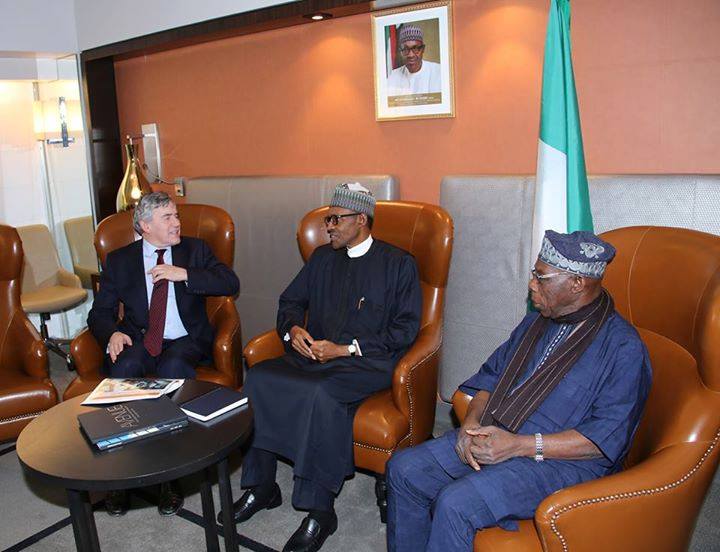
The pictures emerging from New York showing how Mr. Buhari and Mr. Obasanjo are mingling with Mr. Gordon are extremely insignifcant to the welfare of Mama Taju and Baba Chukwudi who are waiting in Ilasamaja and Onitsha respectively for the blueprints on the education of their children and how their future can be ensured.

Buhari OBJ Gordon

Buhari OBJ Gordon

This has been the pattern, that Nigerian rulers and the conquerors of Abuja continue to maintain a distance from the people. The reliance on the ineffective unitary system of government and the insincerity of the state and local governments are perfect scenarios for misgovernance and maladministration-the hallmarks of public service across Nigeria.

I remember the assault on us when Nigeria became 25 years as an independent country. There were all sorts of sponsored jingles on the national TV channels and radio stations.

Arise, salute the nation, come join the celebrations, Nigeria is 25, Nigeria is 25. Every day, every time, this jingle was imposed on our minds and melted into our subconsciousness.

Nigerian rulers are ruthless and they lack respect for the citizens. The jingles in 1960 and the jingles in 1985 orchestrated by the civilians looters and the military gangsters respectively were part of the greater plot to enslave Nigerians.

Sadly in the days approaching 2016 the majority of the Nigerian population are living as slaves. It is even sadder that the people who are living as slaves do not realise this. They have become so pre-ocuppied with different survival strategies that they do not even have the awareness that they  are living the lifestyles they didn’t choose, one which the power to change will always be in their hands.

The immediate post-independence generation is gradually fading away without winning back the Nigeria of their dreams. They allowed the criminal politicians and the military gangsters among them to get away just like that because of tribal or ethnic sentiments among other unacceptable reasons that promote evil over good.

Similarly the entire post-independent generations are entangled in a struggle between hope, promises and fading dreams. They grew up seeing their fathers and mothers, brothers and sisters, their friends and families carting away the treasuries from the local, state and federal governments.

Some of them are direct or indirect beneficiaries of this social malady. The majority are on-lookers shouting every weekend in mosques, shrines and churches. Some are disconnected totally from reality and thereby choose to kill, maim or kidnap others. They turn their anger and frustrations on fellow citizens using religion as a platform. Religion will remain among the most dangerous inventions of man.

As a result of the network of political gangsterism in Nigeria, the fight for a common country with fairness for all was lost a long time ago. It does not appear that the struggle for the emancipation of the masses will be fought again unless the civil society become organised and united.

When I am doing fine and when my family is doing better than our neighbours, l don’t care. This slogan is the hidden Nigerian anthem.

The selfishness and the evil in the hearts of men in any country are stumbling blocks working against the spirit of patriotism and the achievement of the common good of all.

There are radical ways to bring Nigeria back on track.

The government must work for the people and the people must work for the government. The political system must be right and the institutions of government must be functional.

All the things that have crumbled must be revived at the same time. Education, Health, Housing and Roads among a growing list of the things that have made life less worth living in Nigeria. Family planning and citizen orientation will avail much.

At some point the people must find the trigger to orchestrate the fight for what they want and how they wish to live a better life. The government full of corrupt people and treasury looters will not offer it to them on a platter of gold.

It must be emphasized that only an insignificant proportion of the Nigerian population have had it well. Even then they have co-existed with the wretched population in the same environment that is full of abnormalities.

All the sad situations in Nigeria are well known. Some people want critics to proffer solutions and we reply by saying the answer lies in good governance and accountability. It is as easy as doing what is right, condemning what is wrong and making sure you leave every situation better than you met it. How hard is that?

We have added that the political system and the political structures are not working. They give room to the emergence of criminals in public services under a unitary system that makes dictators out of democrats and tyrants out of soldiers.

Nigeria is always at a crossroads, the choices that the people and the government make each time are always on the wrong side of history. For example, Saraki is on trial and the man has not even resigned! Nigerian politicians are special breeds of criminals, hard-heartened and die-hard looters.

What decision can Nigeria make at this time? Another easy question!

After Saraki’s trial and wherever the law leaves him (free or in prison), Nigerians have a collective responsibility to continue this process of cleaning the political and public arenas.

There are Halliburton criminals in Nigeria and they are friends of Buhari, even travelling the world with him! Buhari is not even ashamed of what ordinary citizens are ashamed of. He is not yet a good ruler! It still looks like the birds of the same feather.

Nigerians have the power to occupy the entire country until the judiciary orders the police to produce all the Halliburton criminals in court. Let’s see where the judiciary will leave them when their trials are over.

Why should Nigerians even stop there? There are several hundrerds or thousands of politicians and military gangsters living in Nigeria and abroad who have looted the treasuries. Do they have 2 heads while Saraki has one?

Again, Nigerians have the right to occupy their country or the judiciary until justice served to one is served to all.

There are many ways to move Nigeria forward and two signals that need to be clear are that stealing is corruption and that no one is above the law.

One way not to move Nigeria forward is the ruling government playing the role of the opposition. The APC leadership has perfected the art of responding to PDP’s disruptive PRO machinery. The government that should lead is stupidly playing the opposition because of its lack of creativity and initiative.

As all these play out, if some people remain above the law, more than 90% of Nigerians will continue to live forever as slaves no matter the style of governance.

The way to make Nigeria great is to make every single citizen account for their time and service to country and humanity. Without complete and due accountability, without a system of government that removes power from one man in one place now called Abuja, Nigeria will crawl even when she celebrates 100 years of independence.

aderounmu@gmail.com