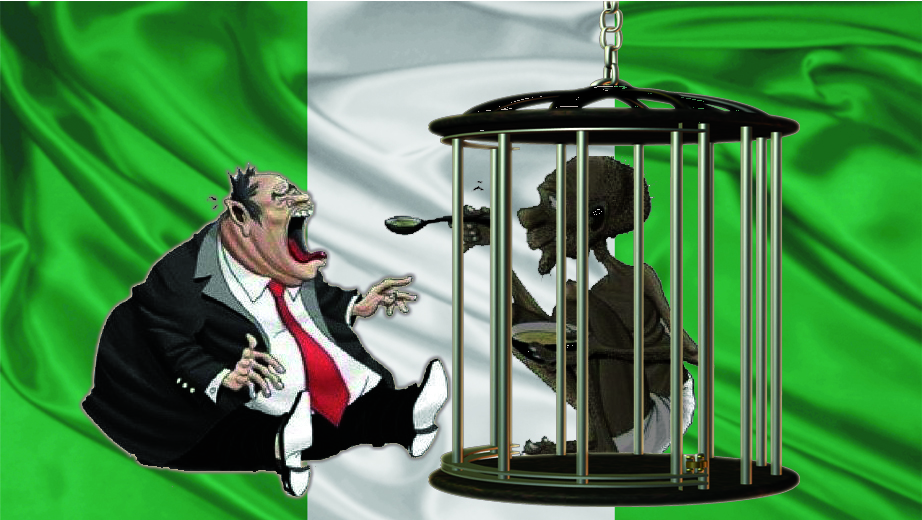
The Kings Are Mad (Part 1)

Hope is quenched when we die. Maybe tomorrow will be better, Mama Esan thought out loudly pondering what she was going to do next as she stood on her feet. She is awake now. Still a voice echoed in her head: what if it is true that tomorrow never comes. Then she sat down again, and wept.

The Kings Are Mad (Part 1)

By Adeola Aderounmu
Adeola Aderounmu

Adeola Aderounmu

Mama Esan ran out of the house. The rain was heavy. She quickly cleared her stall and salvage the remaining items she could grab. Earlier that day she had hoped that things would get better and that her dreams would come true. The heavy rain destroyed almost everything including her temporary stall, her wares and then some parts of the house itself. The roof is always the first part you can imagine.

Her husband has been jobless for 7 years. The dwindling economic fortunes and the total collapse of infrastructure especially the absence of power supply led many companies to shut done their operations. Some of them declared bankruptcy just as a way of getting out of the unrealistic economic environment. If I want food, it doesn’t mean I have to be able to manufacture a gas cooker or an electric heater, one of the affected CEOs declared, proverbially. Then he went to another land.

All of Mama Esan’s children have been withdrawn from their different schools. No one had expected that the cost of education will be so high. No one thought a time would come when there will be no food on the table. But like a pestilence the day came.

In mama Esan’s existence, hope no longer seems to have a place. For her, only vengeance was sure if she could have one. Mama Esan knew though that her situation was not an isolated one. Many people suffer similar fate as she does. Life no longer presented them with choices. For some people the dictionary can as well be rewritten and the non-applicable words deleted.

There is a man called Chinedu. The first time mama Esan saw her was around 1985. He was just a boy. At that time he enjoyed a lot of facilities. But all of those (fading) facilities and infrastructure soon disappeared completely. The best thing in his life was that he got the education he wanted. This was not possible in every part of the land.

When he left high school in 1990 Chinedu decided to try his hands on business and he started as a learner. He learnt the buying and selling trade and gained his freedom when he became an expert. Then he was able to rent an apartment though he was a bachelor at that time. He had his eyes on the future.

However since 1993 no one knew or understood what went wrong. Perhaps people just denied the knowledge of what went wrong with their lives. Some people said the gods got angrier, and others said their ancestors are now restless. Some people read the new foreign holy books and thought they found new hopes.

If anyone had told Chinedu that he was going to be living from hand to mouth in 2014 he would have sworn to Amadiora, one of the gods he knew before 1985, that that day will never come. He would have called the Alusi, if he knew how, to strike the speaker of the strange words.

Now married with children, Chinedu can no longer afford the cost of running his business. It’s too hard now to tend a family. He is terrified everyday and he had seen some people landed in prisons after attempting to push hard drugs as a way to keep their businesses going. The law is not effective but it always catches up with the people who need protection the most, if they erred. One of his friends died with foam puffing from his mouth. The wraps of cocaine inside of him exploded before he could deliver them.

The power generating plants kept breaking down and the cost of petrol for home and business became unbearable. Chinedu gave up. One day he survived an unexpected explosion. The generator was bad but he didn’t know about it. Now, he’s not sure if he should move back to his village with his family. He can go back to his grandfather’s farmland. He is afraid he may be called a failure. His mind kept roaming, as he ponders on the alternative “businesses” of armed robbery and kidnapping. By resisting the temptations, he thought he had rebuked the devil.

Some people think that the devil exists and that he is male. People think the devil should be blamed for all the negative things in life. When he was a student, Chinedu learnt about the culture and mythology of the people in Ebute Meta. He was held spellbound when he learnt that the devil was not Esu. He knows now that it was the invaders who taught about the devil.

Among all the tribes in the land, the people of Ebute Meta, Amuwo and Araromi have no version of the devil in their existence and traditional institutions. It was also the foreigners who invented the term religion and misapplied it. Ignorance ruined the minds of men and they thought that the white man’s devil is the Esu in Ifa’s mythology. Ifa is not a religion; it is a way of life and the explanation for everything associated with mankind.

It was about time the human race laid the blame for global ruins at own doorsteps. Man is responsible for the evil deeds in the world, not an imaginary demon. Man created religion and a place in his own heart called “devil”. Ifa is not human but it can admittedly be either good or bad depending on the man that applies it. When people find evil in (d)evil, maybe they will be convinced that both terms are the inventions of ordinary mortals.

Many people in Ebute Meta are happy for the knowledge that came their way through basic education. But they are now sad because of their misfortunes. What they have learnt have seen them through many life changing experiences. Their hope is that the prevailing problems they encounter will pass away. But what are they doing about these new problems?

There was a man who left Ebute Meta. He went to a very far place in the land called Abuja. He was in search of fulfilment and his name was Muyiwa. He was killed in a bomb explosion. The bomb was set off by the dissidents in Abuja. No one can see the future unless the gods smile down on them and when risks are not taken sometimes, it’s hard to tell what the outcomes could be. After more than 10 years as a jobless engineer in Ebute Meta, this young man was exterminated. He was just 37, which is 3 years shy of age when they say life begins.

Muyiwa was a brilliant man and he was originally from the village of Eniyansoro. He had been told of a job opportunity in the far place. He thought he’d try out his luck. The debt he owed to get to this place of death will never be paid back. The dissidents from the North have now come to Abuja. People say they are also mad because they do not believe in visions but accepted the foreign teaching that they will be alive as martyrs in an unknown place by killing innocent people in suicide missions.

The king of Abuja is foolish. He believes in the devil so he did nothing about this evil when it showed its ugly head. All his life, all he-the king-wanted is power and he chose to dine with the “devil” because he had a choice. He had learnt from his youth that he could dine with the devil by using a very long spoon.

Many of the previous Kings of Abuja are known to have suddenly perished. Some people say the gods must be crazy in this land because they first make the kings deaf and then they destroyed them. But the gods are not crazy. They are probably amused.

Even so because the various kings in the different parts of the land are hypocrites who pretend about the new religions while possessing deep seated intuitions about the gods and they always thought that sacrifices are better than obedience. So they-the kings-make many ceremonies and they give away many unsuspecting fools as living sacrifices. The biggest human sacrifices have always been in Abuja and towards the North of the land.

Money and gold can make people to stop thinking, so they don’t see the evil that other men have planted in their ways. Another selected delegate to the king’s ceremony died 2 days ago and still people want to blame the devil. If the king can kill one of his brothers, who can be free from his thirst for power?

When people are hungry, they also sometimes unknowingly sell their souls. They have no food because many of them left for the cities. They thought they will get rich in the cities. Now with fewer jobs, many of them have no money as well. So the people also said that money is the root of all their problems. How can the people know that the devil is not a demon and that he does not exist? Men clothe their hearts as devils and propagate evil despite the knowledge of the truth with which they were born.

Mama Esan thought about the religiosity of all the kings that she knew: in Ebute Meta, in Abuja and even in the North. Then she wondered who God is and his relationship to Olodumare. This was the first time in her life that she gained awareness of her own thinking about religion. The present king of Abuja took religion to an absurd horizon. No king before him adopted religion as widely and open as he does today. Yet, it is now that the greatest devastations beseech the land. Mama Esan became really confused.

She was not finished with her thoughts. She knows a lot about many of the books her children read when they returned from school. The stories are mostly sad stories. In history, in geography and even in science books, she listened when her children study about many diseases and how some of them are incurable. She’ll be sad if there are no ways for the children to return to school. We are in a hopeless situation, she said to herself. Then she thought that she had a voice in her head “We become religious because we are afraid of death. Yet we die and become dust”.

She woke up drowned in her sweat. She thought about Muyiwa. Ebute Meta is not a big place. Bad news travel fast. She knew about the travails of Muyiwa and many young people in Ebute Meta. She remembered the day Muyiwa and his friends came to her and ask for some items on credit. She overheard him when he told his friends about a foreign film called Fried Green Tomatoes that he had seen and that his favourite line in the movie set in the 1920s was: no one would leave this earth alive.

One day, in order to start a discussion, mama Esan asked her neighbour: what is the meaning of premonition? One of her children had said that he thought Muyiwa had a premonition he was going to die in a far (foreign) place and that was why he talked about the foreign drama and death.

All that is foreign cannot be evil. The power of discernment is one of the greatest gifts the gods left to the people when they departed from Araromi. Muyiwa was philosophical while his travails lasted. He spoke of the several millions like him and wondered from where their hope cometh. He died along with several other innocent people. His hope never materialised and his body parts were shattered. Life can be cruel even to the kind. The evil in the hearts of men and kings does not discern because they think it is the devil’s work.

With all sorts of religions, vices and crimes are committed in the land. The taste of foreign religions left the people in this land in the rhythm of the shadows of mental slavery. It became more devastating because somehow they were not able to differentiate between rites and faith.

This king of Abuja became a master in the philosophy of modern religion. The dissidents from the North have their own ideas about it. The people are suffering and there is confusion everywhere.

From everything the people hear and see they also fail to realise that their freedom and way back to prosperity will lie in their power to discern. They must know the truth so that they can be free. Else there is a risk they will become slaves to anything that they do not understand.

Muyiwa was one of those who believed that life started and will end on earth. He had a premonition but he didn’t know it. He was a kind fellow and he lived in peace with everybody though his heart was always troubled in his private moments.

Hope is quenched when we die. Maybe tomorrow will be better, Mama Esan thought out loudly pondering what she was going to do next as she stood on her feet. She is awake now. Still a voice echoed in her head: what if it is true that tomorrow never comes.

Then she sat down again, and wept.

(Watch out for part 2)

aderounmu@gmail.com

US Army, Nigerian Army and Boko Haram Playing Hide and Seek In Sambissa Forest?

By Adeola Aderounmu

I don’t know who is having a laugh or a rough time now among these 3 gangs. I mean the US promised intelligence and provided it. At what cost I don’t know and I’m sure many people do not care the cost as long as the “Chibok girls” are found and Boko Haram esterminated from the surface of the earth.

But many people have been disappointed and they are like: you mean the girls have not been found! You mean the US in Nigeria is not doing the magic? wao!

Well, sources have it that the US provided images on the movement of Boko Haram to the Nigerian Army. But what is the Nigerian Army doing? The Nigerian Army is avoiding the locations where Boko Haram operates. So rather than use the information from the US assistance to curb Boko Haram, it turned out that the Nigerian Army is using the information to actually avoid Boko Haram. This is very serious but laughable.

The Nigerian Army over the years have sold many of its weapons and ammunition to Boko Haram. Boko Haram is a big threat to the Nigerian Army that is full of treacherous fellows. We knew that before the US came, but now we have a confirmation that they are not only treacherous but also fearful.

This is the same army that stopped the war in Liberia, Sierra Leone and made impacts in Congo. At home the Nigerian army is a failure. But this is not a sudden occurence, it was a systematic breakdown coming from the failure of governance and the roles of the Northern elites.

The Northern elites remain pleased with Boko Haram if that is what we bring them back to the presidency in Nigeria in 2015.

The way this whole mess is playing out and with the murder and massacre of Nigerians in Northern Nigerian and Abuja, the Northern elites will wake up soon to realise that they have been chopping off the fingers that feed them knowingly or unknowingly.

Governance in Nigeria is a huge joke anyway with the ruler Mr. Goodluck apparently not feeling safe outisde the Aso rock and bursting off any visit around troubled areas. He is so scared of the Nigerian army he feels like one of them can sniff his life away. This is the state of loyalty of the Nigerian army to the Nigerian nation.

Goodluck Jonathan is a coward, but playing smart in a small confine. He should have rounded up all the former and serving generals and civilians who promoted, supported and financed Boko Haram. He was so slow things got out of hand. He may have been part of a terror cell himself which will seem logical too. I agree it is more complicated than that but doing nothing at all because of selfish interest and political power is costing Nigerians innocent life. Add to the injustice and madness of corruption in Nigeria, this is hopelessness for the common people.

So, no the girls are probably gone a long time ago. Boko Haram had all the time in the world to diaply arrogance and “freedom”. The hide and seek game is very insultive to the collective inteligence of informed Nigerians.

I don’t know how Nigerians can co-exist in 2015, it will be one of the greatest miracles of all time if Northern Nigeria (now harbouring PDP “settled political prostitutes”) goes along with a Jonathan presidency in 2015. How are they going to conduct elections around Nigeria with bombs dropping daily? If elections are held only in certain parts of Nigeria, will that count as national elections? How far will Boko Haram take this war as the Nigerian Army plays the handicapp? The thriller will be another box office hit.

Nigerians, You Lost A Paradise (A Photo Essay)

By Adeola Aderounmu

In several of my essays on Nigeria I have made references to what my parents told me about Nigeria. I remember one story about my mother walking about Lagos in the middle of the night. She told me there was nothing to be afraid of living in the old Western Nigeria. People lived like normal people and go about their businesses round the clock.

There was 24 hours a day form of existence, transportation was uninterrupted and life was full of hope and happiness. The future looked super bright. When she told me stories about Nigeria in general, she brought the good olden days in Western Nigeria to life in my imaginations.

Unfortunately for Nigerians the future is here now and it turned out super bleak-full of extreme hopelessness and frustrations.

Invariably Nigeria was once upon a time a paradise on earth until some people decided to reverse the gear of progress. Greed and outright madness took over the people-both civilians and military-entrusted to manage the affairs of Nigeria. Sometimes these people have not been chosen, selected or elected; they took over governance by force or through violence. Then they enforced their own rules and mode of governance.

Nigerians lost their paradise when they could not take back the control of their regional and geographical areas from the tropical gangsters who strangely are somehow still in control of the affairs of the land until today.

My mother told me that security especially took a turn for the worse after the civil war ended. In general, evil rose after the war as weapons remained in the hands of the people. Greed and selfishness set in at different points during pre and post-independent Nigeria.

In many ways too numerous to describe here, Nigerians lost a paradise

Cross River Conical Stone

Cross River Conical Stone

This conical stone is from Cross River State. It stands in front of the National Museum in Lagos. One of the things that went wrong in Nigeria was the drop in the standard and value of education. How many Nigerians visit the museums to learn about their history? Today the ignorant people who run Nigeria’s education have suggested that history should be removed from the curriculum. Nigerians will forget their history totally and the magnitude of historical distortions 100 years from now will be better imagined than experienced.

Brass smith in Bida

Brass smith in Bida

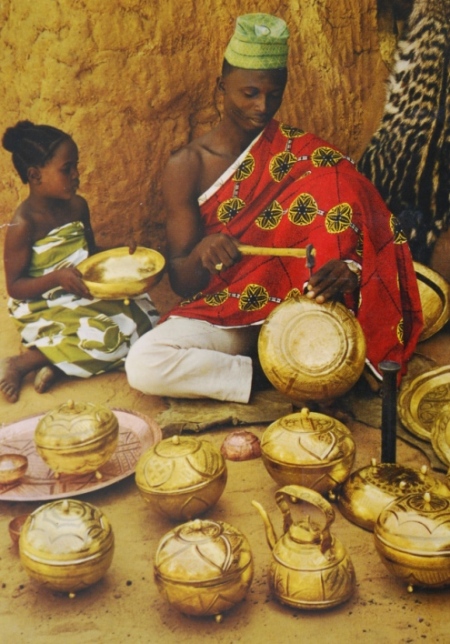
This is a man doing his work. That was Brass smith in Bida. We always say there is dignity in labour. Today that expression belongs to the dustbin in Nigeria. Several Nigerians just want to be part of politics so that they can steal and accumulate money and wealth for themselves, their families and unborn generation.

Those who are not stealing in politics are also looking for ways to cut the corners in whatever they do. In public and private enterprises the “make quick money syndrome” has taken over almost everybody. People now believe more in “if you cannot beat them, join them”. Such is the low mentality of an average Nigerian today.

Honesty is now a disease in Nigeria. People who are honest and trustworthy in Nigeria have joined the list of endangered species. One day somebody told me that I cannot be a politician in Nigeria. When I asked him why, he told me that people working with me will either kill me or poison me if I prevent them from stealing in politics.

He said they might even cut my head off. He was trying to emphasize that I cannot do politics in Nigeria if I am not ready to steal. From what we see and know about Nigeria today, that illustration is correct. It’s very sad, disheartening and a piece of the evidence that the paradise may be lost forever.

Decorated Pots, Sokoto

Decorated Pots, Sokoto

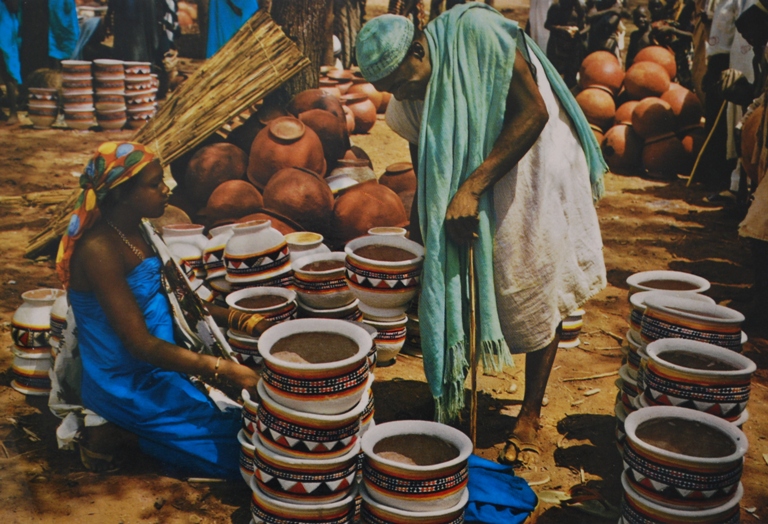
Here above is an image of a girl selling decorated pots in Sokoto, Northern Nigeria. This must have taken place at those times that my mother described to me and what I will call Nigeria’s golden years. At that time when there was still dignity in labour. Some of the pots are not decorated but they look so beautiful you want to have them for your next party or family cooking.

Old Western Nigeria

Old Western Nigeria

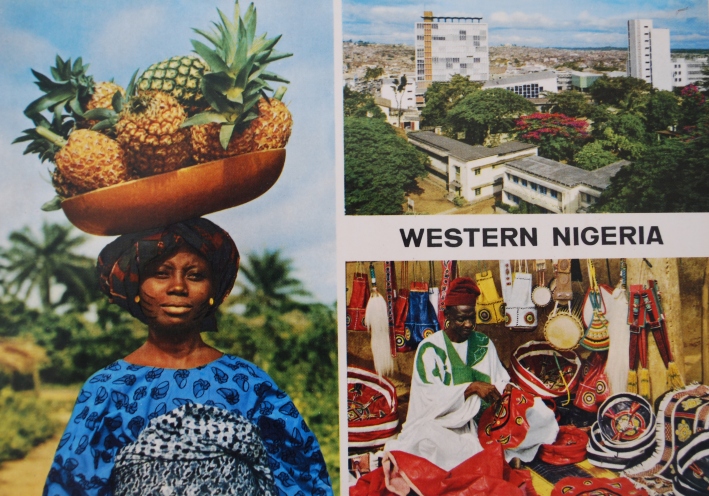
Western Nigeria was part of the regions that made up the Nigerian paradise of the olden days. It is hard to miss the blend of even development and environmental preservation. Look at the beautiful trees among the industrial revolution of old western Nigeria.

One cannot miss the hard work and the quality of the products that this craftsman is making. The image did not say where the man comes from but he was well dressed in native agbada. Interesting I have at least 4 of the items in his production line in my possession.He was not only selling cultural products, he promoted his culture as well by representation.

The woman carried healthy fruits. She was also well dressed in Iro and Buba. She looked healthy and happy. She was probably selling the pineapples or just on her way from the farm. Agriculture was the backbone of the Nigerian paradise. Crude oil later became a curse.

A Market Place in "old" Nigeria

A Market Place in “old” Nigeria

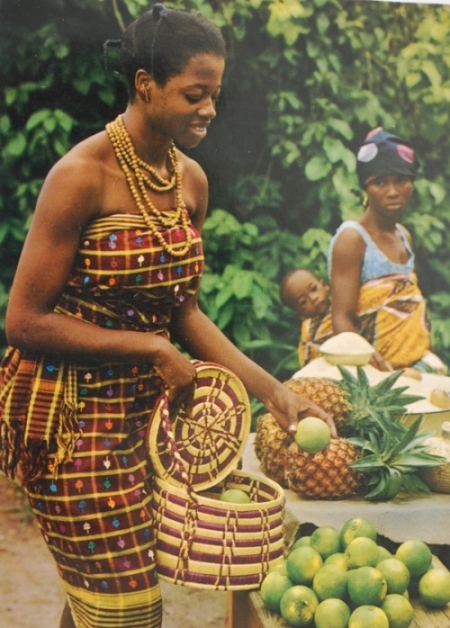
This is another beautiful image from the time when Nigeria was a paradise on earth. It was at that time that it would have been proper to describe Nigerians as the happiest people on earth. Some recent global reports describing Nigerians as the happiest people in recent years when the security is low, the roads, schools and hospitals resemble monuments of catastrophe, the economy is good enough on paper only and at a time when majority of the people are living dangerously from hand to mouth, are not only misleading but also irony of the highest order.

The Famous Kano Mosque

The Famous Kano Mosque

In my recent but last essay I described religion as one of the greatest problems in Nigeria. Religion is one of the reasons why Nigeria went from paradise to hell on earth. These are people worshipping peacefully at the famous mosque in Kano. People worshipped peacefully across Nigeria in the olden days. But the agents of prosperity in the face of dwindling economic fortunes changed the mode of worship in Nigeria forever.

Rather than guide the people to demand good governance and accountability, the foreign religious institutions in Nigeria headed by the new-age Nigerian overseers told people to pray. At the same time the people whose actions and activities contributed to converting Nigeria from paradise to hell were active members of various religious organisations.

The situation remains the same today as looters parade churches and mosques every Friday and Sunday. Nigerian looters are popular faces at religious crusades. Religion became a means to wealth for the religious rulers and many young people today are religious fanatics especially after years of joblessness. Politics in Nigeria got contaminated with religion and the outcomes including terrorism and mistrust in the society remain devastating to this day.

Nigerians love to chase shadows. Oh! How they enjoy denying the knowledge of basic truth! Apart from the resurrection of regional governance (the possibility of which is already being thrown away at the “organised” national conference) another hope for the restoration of the Nigerian paradise will be the total eradication of religion(s) from public service.

Issues like pilgrimages for example need to be taken away from government functions. Churches and mosque in/around government establishments need to be demolished. People need to just do the right thing rather than hide under the umbrella of religion while they ruin the state or country.

People don’t need to pray for good roads, good schools, and good hospitals and so on. What Nigeria need across all her geographical regions are the good and honest people who will use the budgetary allocations to do these things. Prayers don’t build roads or schools when the funds have been stolen or embezzled. That is common sense and application of the knowledge of the truth – that which always set people free.

Meeting of the "WAYs" Water, Rail. Road , Old Lagos.

Meeting of the “WAYs” Water, Rail. Road , Old Lagos.

In this picture we see some of the things that millions of Nigerians today have no experiences of. There was a functional train in service. The roads are clean and motor-able. The cars were in the correct lanes-2 lanes and no mad driver on an artificial third lane. There are no LASTMA people on the road; people had a sense of belonging and responsibilities.

On the right side the area is enough for pedestrians and cyclists and on the left side, there is a bicycle track along the major road and also there is a pedestrian path with adequate distance to the train tracks. Life was good, normal just like in a paradise. The street lights are standing upright and there is a stretch of beautiful garden in the middle adding glamour, peace and tranquillity to the streets of Lagos in the old western Nigeria.

Apart from air travel, all the other modes of transportation are depicted in this image. There are no ferries in the image but the idea was to state that they were all available in the old Lagos.

This is the type of image of Nigeria from the past that some people will never know about. Millions of Nigerians have lived and died within the period that the paradise was lost. This means that they actually, sadly enough, passed through life without the experience of a good life or the taste of the real meaning of life. If nobody talks about these things and if nobody makes reference to the things that existed under regional governments millions of Nigeria will live and probably die not knowing that there entire future and happiness were stolen from them even before they were born.

All of my life time in Nigeria, I do not recall the privilege of taking a ride on the train. One day however I took the “Baba Kekere” ferry service from Mile 2 to CMS. It must have been some time in the mid 80s. But as a young boy I remembered the many rides on the LSTC buses in the late 70s and early 80s. I know the number on the buses and their destinations from Festac Town. Those were the end of the good old days.

In today’s Nigeria the paradise is lost. This lose will be permanent for several millions of Nigerians living in Nigeria unless radical political changes and turnarounds occur today.

The paradise will remain lost if one man or a group of people can steal 20 billion dollars and walk free. In the 1970s we saw a man making brass in Bida, in the 80s we saw a man from Minna who stole more than 12 billion dollars of Nigeria’s oil money. He walked free! How did Nigeria go from promoting dignity to embracing criminals? The answers will shed light on how to lose a paradise in 20 years or less!

Nigeria lost their paradise because they allow military juntas and politicians to handle public services and politics like profitable businesses that is devoid of probity and accountability. The paradise will remain lost in the face of non-sensitive rulers and non-functional political structures.

The negative outcomes that follow a lost paradise are too numerous to elaborate but they are largely visible on a day out in various parts of Nigeria. Nigerians need orientation in almost all aspects of their lives. Social studies, moral instructions and history were part of the foundations and orientation in primary education. They still cannot be overemphasized in a society with solid foundation in education.

In a lost paradise, pensioners are crying, students are not getting the correct education, graduates are jobless and the society is on a free fall. In Nigeria, a country heavily polluted from all angles, good health is a luxury. There are almost no consequences for political and economic crimes. There is no sense of belonging and the first and the last law is the same: the law of self-preservation.

When I think about the issue of electricity in a lost paradise, I can’t recollect much from Obele Odan in Surulere but it has always been a pain to recount what we went through in Festac Town. We got a beautiful town with our own transformers and local power system.

Everything went down the drain right in front of our eyes. Growing up in Nigeria for my generation was a traumatic experience. Yet we were not given any social or psychological help by the state or the federal system. We fend for ourselves.

At that time (when I was growing up) the system was under the management of the wasted generation. These are the words of Wole Soyinka, as he aptly described his generation, my parents generation unfortunately. Until this day in Nigeria, the mis-management of Nigeria remains largely in the hands of mostly crooks, criminals and idiotic people who cannot manage their homes. How they got to the positions where they have to manage public services and government institutions summarises the story of Nigeria as a lost paradise.

A paradise can be reclaimed. Nigerians, you lost your paradise when you gave up your sense of belonging in the various regions and allowed a powerful center to destroy the entire system. You cave-in and followed a “rotten head” all the time. The paradise lost is actually the sum of all your negligence and attitude to work, environment and life.

It’s going to be a hard fought battle, but you need to bring back the paradise for the sake of your children and children’s children. Take another look at the images in this essay; you’ll see there’s a need to do away with the rotten head or any rotten head for that matter.

Do away with the center altogether. Claim back your regions, do the right thing all the time when it comes to public service and dedication to local and regional development. Be selfless and content. Start your charity (in this case your love of humanity) again, from home. It will spread. It will bring the paradise your children deserved.

aderounmu@gmail.com

PHOTO CREDITS

Akwashi Conical Stone (from Cross River Area)

(By Elisabeth Seriki)

Brass Simth Bida

By John Hinde F.R.P.S

Decorated Pots, Sokoto

John Hinde

Western Nigeria

John Hinde

Famous Kano Mosque

John Hinde

Market

Photo by E, Ludwig, John Hinde Studios

Lagos, Meeting of the Ways: Water, Rail, Road

By The Railway Printer, Ebute Metta

Terror And The Volatile Mix Of Blind Faiths

By Adeola Aderounmu

One of the saddest things to occur in Nigeria in the last 4 years is the ascension and domination of religious politics. Unfortunately, it has also been the time of putting Nigeria on the map permanently as one of the major terrorists’ countries in the world.

Nigerian politicians have lost the plot a long time ago in the areas of ideologies and functional manifestos. It will amount to overstating the obvious that Nigerian politics runs on faulty foundations and that the essential purpose of politics in Nigeria is nothing close to service. The politics is rather self-serving, self-rewarding, dominated largely by criminal minds and stinking of massive corruption from the head to the toes.

Religion is destroying Nigeria

Religion is destroying Nigeria

As Nigeria and Nigerians now approach the 2015 elections, the stage is now set for a religion-influenced electioneering. How did Nigeria get to this point? The question is relevant judging from the background and outcomes of the 1993 general and presidential elections. That election was adjudged to be the best election (ever) conducted in Nigeria.

Sadly for the Nigerian nation the presidential election results were annulled by the tropical military gangsters headed by one dictator called Ibrahim Babangida. That election would have ushered in MKO Abiola and Baba Gana Kingibe of the SDP, two Muslims from two different geopolitical zones in Nigeria.

When Mr. Goodluck Jonathan started his reign as the ruler of Nigeria in 2011, it was not pleasing to the Nigerian opposition party and a lot of statements were made by the opposition politicians especially those from the Northern parts of the country. Gen. Buhari and Mr. Atiku were alleged to have made statements that ordinarily would have earned them interrogations by the Nigerian special security forces. But they were not invited for any interrogation or explanations.

There had always been elements of terror and its tendencies in Northern Nigeria. There was of course serious problems with the terrors in the Niger Delta that curiously to this day continue to gulp more money than the federal defence budget of Nigeria. However for some reasons that have now kept the blame game in a roller coaster mode the terrorist group popularly known as Boko Haram have flourished in the northern parts of Nigeria and Abuja under the reign of Goodluck Jonathan.

This period of rise of terror curiously also coincided with the era when Mr. Jonathan embraced the Christian community in Nigeria with more enthusiasm. He even went on the so called “holy” pilgrimage with a large entourage, all on Nigeria’s tax payers’ money.

By the way the annual holy pilgrimages to Mecca and Jerusalem are embodiments of the nonsensical waste in Nigeria’s government since time immemorial. Nigeria is a very corrupt country (we don’t need corrupt Mugabe’s opinion to confirm this fact) and the wastage or looting of money through religious tourism to other countries is regrettable. These pilgrimages are parts of the inferior complexity of Africans, also regrettable, made famous by the government and people of Nigeria.

The APC is yet to state with audacity the two persons who will be flying the flag or the brooms of the part in the 2015 elections. An attempt to draw a ticket on 2 individuals with the same religion like the SDP did in 1993 is becoming unlikely and like their party members and critics would make everybody believe-suicidal.

The disorganised polity has been heated and whether the Muslim community or the APC in Nigeria find it desirable or not, there is no longer a general acceptance for the type of scenario that Nigeria had with the Abiola-Kingibe ticket. Since the political scene is devoid of common sense and ideologies, the rise of Boko Haram has given many religious people within and outside APC the platform for hatred. Offshoots of the hatred are the emergence of the political suicide syndrome and the probable intense Christianisation of the Nigerian presidency under Jonathan.

The alleged statements made by the likes of Buhari and Atiku at a time when they needed to control their emotions but lost it completely, and the silence/lack of condemnation from the Northern region in general following the “successful” campaign of Boko Haram continue to send shocking and conflicting signals across Nigeria. It will be hard to erase the meaning and aftermath of what it takes to make Nigeria ungovernable. Such expressions now run parallel with terror occurrences.

The government of the day in Nigeria has made many remarks in the past and even recently linking the deadly terrorist group to the main opposition party-the APC. Nigerians are surprised because such allegations are supposed to be supported by investigation and arrest. Nothing has happened in that line. Before he was killed General Azazi linked the problem to religion, poverty, the desire to rule Nigeria and a combination of everything that is wrong with Nigeria. He especially laid the blame at what he called politics of exclusion of the PDP in the region.

When the true story of Boko Haram is finally told, it would be instructional, not least sensational to know the sponsors (national or international) and the roles of the Nigerian military that is alleged to be harbouring snitches who have made the bloody operations of Boko Haram successful. What will also be useful if Nigeria or the nations within Nigeria will ever learn anything from history is the magnitude of the alleged involvement of the Northern rulers.

I doubt if I know what to believe going by the nature of the roller coaster blame game. The Yorubas have said it all “if falsehood persist for 20 years (or even 100 years as Nigeria marks centenary of a painful marriage), one day the truth will emerge.

terror

Meanwhile in the faces of the multitudes of speculations, allegations and counter allegations and irrespective of where the actual truth lies, it is extremely sad that those who have suffered the most are the innocent masses going about their occupations or daily activities. Women and children have suffered in this evil campaign and crimes have been committed against humanity.

It appears that the government of Nigeria enjoys playing or toying with the lives of the citizens. This whole pandemonium is like a chess game where the opponents are seeking checkmate. In this case, the 2015 election is the end result. The “I don’t give a damn attitude”, the lies of keeping government “working” and the campaign dance that took place in Kano barely 24 hours after the deadly car park blast in Abuja that claimed, depending on sources, between 150 and 250 lives are all indications of a failed government.

Religion in its ordinary form mixed with politics is poisonous. The effect of contaminations with radical views either from the presidency or any other place in Nigeria will be more potent than a poison. Nigeria appears to be in a labyrinth, more likely at the crossroad of self-destruction.

In January 2011 I wrote an article titled: My Message To Nigerians In 2011, Stop Saying It’s God. I condemned the influence of religion in Nigeria’s politics and social life.

Nigerians have been fooled, deceived and slaughtered at the altar of ordinary and radical religions. It does not seem there is an end in sight if one judges by the religiosity of Nigerians on the social media and in reality while the country burns.

Is it hard to see that Nigerian politicians (both Christians and Muslins) are looting the treasuries across Nigeria? Is it hard to see that they call on God and Allah to solve the problems that are related to common sense and simple political ideologies?

Nigerians and their politicians attribute events (good and evil) to acts of God and they merged together to pray for things that can be solved by simple action and will.

In the area of religion and prayers, I have not understood the Nigerian mentality. They pray for the things that they and the government are supposed to do. So after creating a corrupt political system where corruption and crimes are tolerated and rewarded, Nigerians will then commit everything into the hands of their various Gods. Nonsense and ingredients!

For Nigeria, religion has created more problems than solutions. It remains a deadly veil for both Christians and Muslims. It’s worse for radicals anywhere because the effects of brainswashing are profound on them and their narrow minds. It’s going to be mission impossible to forbid religions in public positions, in politics especially. Ironically the elimination of religion in our doings is supposed to be the best way to free our minds and promote coexistence.

It’s hard to “converge” my views but I’m trying to get to a point where I need to condemn the role of politics and religion in the rise of terrorism in Nigeria. I am of the opinion that religious differences have aggravated the political differences in Nigeria. I think that the corrupt rulers and politicians have through their actions, alignments, attitudes and utterances contributed to the hopeless situation in Nigeria.

I have a problem in understanding the rise of Boko Haram acting on the radical angle of one of Nigeria’s dominating religion, that is Islam. A few years ago, Nigerians boasted of their “fear” of dying. Today we are told there are suicide bombers in Nigeria. It’s very painful to watch terror achieve successes on the back of religious platforms. I’ve been blown away many times in my life seeing atrocities committed in the name of Christ, God and Allah.

I also want to emphasise that as long as religion remains a factor in Nigeria’s politics and socio-economic life, then the country is going no where. In the society, people need to start doing things independent of religion. Just be good, do the right thing and play your role in nation building!

The Nigerian political class does not build or propagate sane and sound ideologies; they are instead wiggling from one political party to another based on the religion of the political candidates, based on fairweatherism and opportunism. That is the height of stupidity, having no principles.

The call for true federalism or the emergence of regional governments cannot be swept under the rugs. For, right now, Nigeria is in a serious dilemma and the center is too weak to hold things together. The center is marrying, making merry and dancing around as the country burns and people perish daily.

The weakness of the center is the strength of Boko Haram, it is the strength of militancy or terrorism anywhere in Nigeria. The weakness of the center is the sustenance of a corrupt political system. The self-serving nature of Nigerian politics means that the non-thinking politicians and rulers are ready to take everything down with them. It is up to Nigerians to rise up above religion, above sentiments, above hypocrisy and above political and ethnic differences.

Great countries were not built on religions, corruption, selfishness, greed, prayers or miracles. They were built by dedicated people, on sound political structures, on performances, on ideologies that stood the test of time, on positive actions and on the collective will to succeed.

aderounmu@gmail.com

The Nigerian Syndrome

By Adeola Aderounmu

The Nigerian syndrome is the condition in which the people of Nigeria openly support their rulers and politicians who have contributed tremendously to the demeaning of their living conditions.

The Nigerian Syndrome

It is a also a condition where a crook, a corrupt ruler or a known criminal in government gets massive support from a group of die-hard followers who will never see the negative impacts of the criminal acts that have been perpetrated.

For example, James Ibori has/had supporters who even went to a London court to support the cause of him being a criminal. When Alamieyeseigha ran away from London to Bayelsa State he received a heroic welcome.

There are uncountable examples. Alamieyeseigha was even granted pardon by the massively corrupt Jonathan government meaning that the syndrome is displayed not only by individuals but also by the government. Bode George’s criminal charges and ex-convict status were removed by a court of law. His supporters took to “aso-ebi” with religious songs and they celebrated him as a criminal while his trial and imprisonment sailed through.

The Nigerian syndrome from the foregoing is suffered by individuals, government and institutions in Nigeria. When the complete analyses of this syndrome are done, it will be worthwhile to do a comparison of it with the popular Stockholm syndrome.

The Nigerian syndrome will definitely open a new chapter in anthropology and human/animal behaviour. It will be a study area that will explore corruption, tribalism, nepotism, extremely low human cognitivity, non-performance in government and many more vices that are related to hitherto inexplicable situations surrounding the mad politics in Nigeria.

For it is amazing how over 53 years of misgivings, mismanagement, maladministration and complete destruction of the institutions of government has not drawn the ire of the Nigerian populace in a united and collective way. It is very disturbing how voices of reasonings have been suppressed and replaced with voices of humans with distorted or frail mentalities.

There are several documented examples of how the people of the states or the regions that have been robbed showed open support for the the criminals that have robbed them through the looting of the treasuries. Sometimes the support cut across states and regions.

It is well known that corruption is systemic in Nigeria and that Nigeria is one of the most stinkingly corrupt countries on the surface of the earth.. Therefore what some Nigerians have done is to compare the degree of corruption of each administration. For example rather than condemn and prosecute Obasanjo, Babangida and all the other corrupt rulers of Nigeria, Nigerians find it more “befitting” to compare the level of corruption in these governments and take sides depending on their “feelings” or “nepotic inclinations”.

Actually, this is worrisome because the ideal thing to do is to condemn all these corrupt rulers and their ministers and accomplices in the government houses across Nigeria. Nigerians don’t condemn corruption in totality. They weigh corruption, especially on tribal scale.

The fact that Jonathan did not start the corruption business in Nigeria has earned him massive support among some groups of Nigerians who are only interested in the emergence of a christian ruler or a ruler from the South of Nigeria. Nigerians are slaves to religion too.

The Nigerian syndrome itself is systemic and and as mentioned earlier deserved to be studied in details. The Nigerian syndrome will make up more than a 4-unit course at any University. It  gets wider. In Nigeria intellectuals who are recruited into the government are known to have been part of the looting in government. Journalists like Reuben Abati whom everyone thought can reason logically because of the way he wrote went into government to defend the criminals he had criticized for many years. If you read Abati’s articles while at the Guardian, the complexity of the Nigerian syndrome will take a new turn.

What is it with the mentalities of the ordinary Nigerians that allow them to support the way the government is maltreating them? Why can’t Nigerians see that the government is bad and make a determined and collective efforts to ensure that the government is geared towards competency, accountability and probity? Why do people in government end up as criminals even when they were good people outside of government?

The Nigerian syndrome include the myopic views that Nigerians have on national issues and also their short-term memories of issues that have long lasting effects.

What is wrong with Nigerians? Why do they grade corruption rather than condemn it altogether? What is the relationship between corruption, tribalism, nepotism and Nigeria’s system of completely mad politics?

What is the cure for the Nigerian syndrome and does this cure hold the key to any attempt that will be made to eradicate corruption? In short, is there hope for Nigeria with the system of government that is in place?

aderounmu@gmail.com