The Boy With The Golden Ears

When l arrived at the hospital, l met the nurses and did the necessary registration for the day. Then l waited. I waited, and waited and waited. When l got unsettled by the unusual long wait, I asked the nurses when it would be my turn to be attended to.

The Boy With The Golden Ears

By Adeola Aderounmu

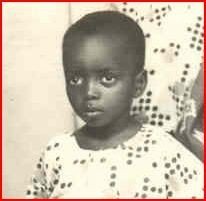
Adeola_4years_old

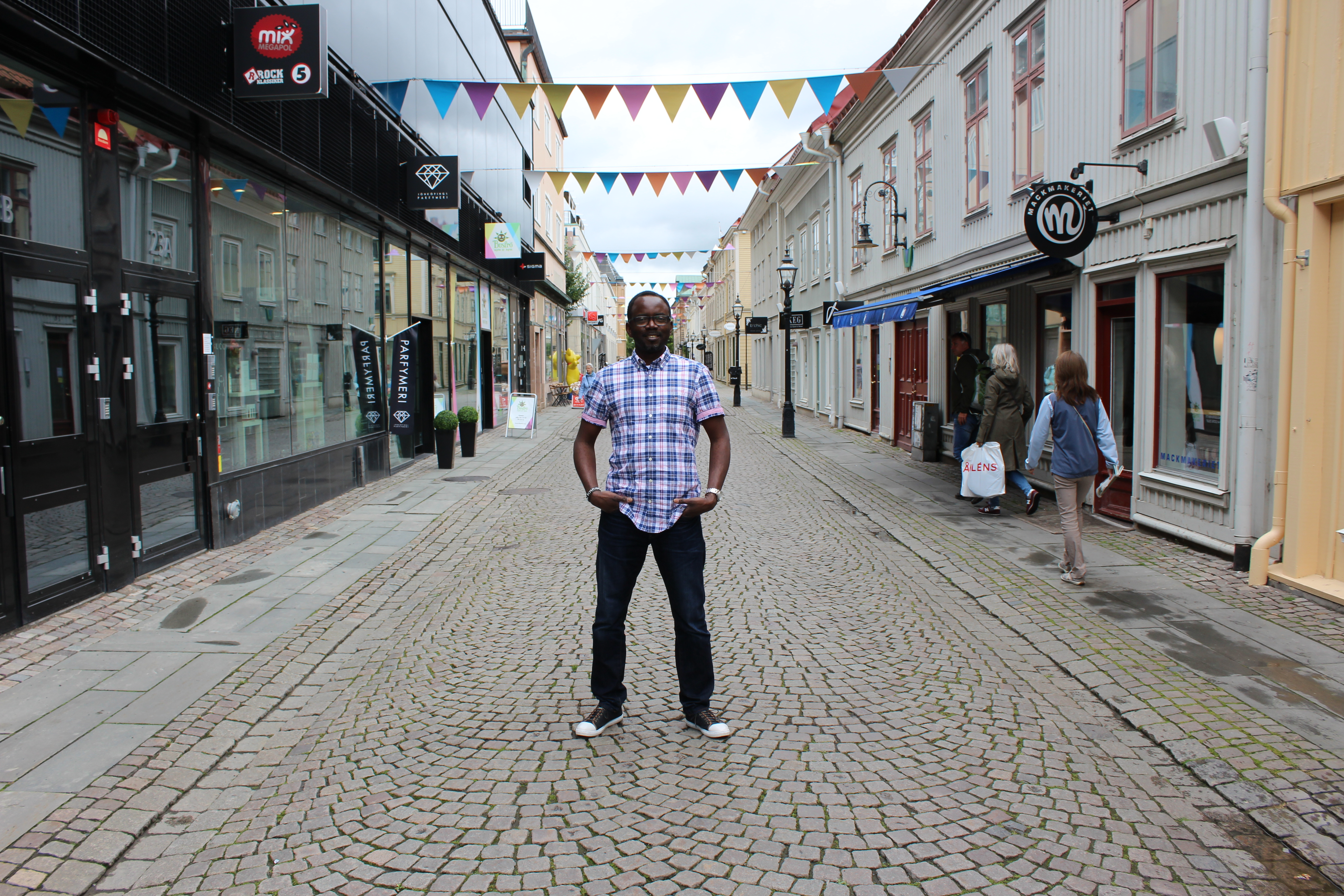
Adeola Aderounmu

In 1986 as a 14-year-old boy, I took the bus and went to the General Hospital in Lagos for an ear operation. It was supposed to be the end to a series of visits and appointments at the hospital. When l was born, my ears were not ready. The defects were so obvious that my ear tunnels were usually loaded with yellowish fluids.

My childhood memories would be totally incomplete without the agonies of my mother who sat and watched my infant head decorated with 2 defective ears.

I remember my childhood, during the primary school days. I was always loaded with cotton wools at home and sometimes l took them to school. Soon l learnt how to wrap cotton wool around a broom stick and stuck them into my ears right and left.

On so many occasions we ran out of cotton wools. What did l do? I turned to the cover of my BIC pen. The lid became my best companion for several years. If l didn’t have anything on me, l had the lid of a blue, black or red BIC pen.

I stuck the object into my ears and excavated tons of fluids from them. When l found cotton buds later in life, l used them. They were valuable, like gold.

When l look back now, l am so grateful to my mother for all the efforts she put into cleaning my ears. I can remember she warned me against the sharp objects. Sometimes she just looked at me with pity because in my case, it was similar to living with someone with an addiction.

I mean with my ear problem, when the urge to put in something into my ears surfaced, there was nothing in the whole world you could do to stop me from inserting any available object into it.

I am also grateful that l wasn’t classified as a handicap because Nigeria could have destroyed me totally in that sense. I was lucky not to be categorized as someone who needed special education because of my hearing difficulties.

Prior to that day-the day of the operation, l’ve learnt to wake up at 5 a.m. in the morning, joined the bus and made the journey from our home in Festac Town to the General Hospital situated at Ikeja. We, that is my mother and l usually get off the molue buses at the PWD bus-stop and then trek beside the bridge all the way to the hospital.

It was an inconvenient journey. It was not totally safe because it was always still quiet with few people on the way by the time we walked beside the bridge towards the hospital. My estimation puts the journey at about a 40 km stretch, maybe 50. It could take an hour and a half with at least 2 or 3 bus connections.

On the day of the operation, my mother let me made the journey by myself. She would come after me later on. I don’t remember the sequence that led to the decision but if you are a mother of 6 children, you soon learn to make them independent at the appropriate age.

I would imagine now that l had won my independence by the time the doctors decided that l would be operated to correct my ears.

When l arrived at the hospital, l met the nurses and did the necessary registration for the day. Then l waited. I waited, and waited and waited. When l got unsettled by the unusual long wait, I asked the nurses when it would be my turn to be attended to.

The response l got was a shock, one that l will never forget.

This is the hospital l have visited several times with my mother. I had become a regular customer. In fact, one day l got a tiny piece of fish bone stuck to my throat whilst eating some delicious meal. I could not sleep that night and my mother had to take me to the ENT.

I knew the Ear, Nose and Throat department at the General Hospital in Ikeja like l knew the palm of my hand.

When they told me that they couldn’t find my file and the documentation that stated that l would be operated on that fateful day, l thought it was a “simple” mistake of misplacement. I thought they would find it and my ears would be operated.

When my mother arrived she was very upset. She gave me a correctional slap to express her anger. I cannot remember any other day before and after this fateful day that my mother had slapped me. She never did.

As a child l was very confused.

The nurses could not find my files. Who should have been slapped?

Now when l think back about the entire scenario, l can guess a few reasons why my files were missing.

One, the nurses were probably in shock that a boy showed up for his own surgery. Where was my mother who could pay the tips so my file does not go missing on this important day?

Two, from another perspective, were they expecting that my family would have made advance contact and advance payment prior to the day of the operation? How well did my parents realize that such opportunities must be “assured” by keeping a tab on the nurses and doctors to avoid disappointments?

Why did my file go missing on the day of the operation?

Three, did the doctors chicken out because they were incapable of carrying out the operation? The last statement is quite unlikely because my memories portray an array of competent, professional doctors with tools and instruments checking my eardrums, ear infections and throat as an out-patient.

Still, why didn’t the doctors remember my appointment? An operation should not be something that one should just forget like that? Why didn’t the doctors come to the waiting-room to look for me? Did the nurses tell them that l was no show?

What actually went wrong? My mother slapped me because she found me sitting calm and collected despite the scenario of likely missing my one-in-a-life time opportunity of correcting my defective ears. She probably knew at once that the chance will never come up again.

Many things must have gone through her mind when she arrived to hear the latest bad news about my ears. They easiest avenue to let go of her frustration was the slap l got. She probably thought l just got there and sat down without making any effort?

What can a 14-year-old do when the old nurses had thrown away or hidden his medical files?

I can’t remember ever getting angry at my mother. She was my god. She was the woman who taught me almost everything-how to read, how to write and then how to cook. My mother taught me humility and perseverance even in the face of difficulties and adversities.

So we went home. There was no operation in 1986. I continue to insert everything into my ears to take out the fluids and to “scratch” my ears when they itched. At some point, l used sticks and brooms to pick out dirt that are fastened to my eardrums.

I thought l had become an expert of my ear. If l was an ear doctor, l would be the best in the world.

I remember one day when I was picking my ear with a broom stick and suddenly somebody ran into me. I bled from my ear and of course that was also another opportunity to insert more things to bring out the blood. My addiction was hopeless.

I have been living in Sweden since 2002. I continued to suffer regular ear infection because of the vulnerability of my eardrums. So one day when l visited the doctor, he recommended an operation. I mean my ears were tested over a period of time and the results l saw were heartbreaking.

I have been straining myself almost all of my life to hear what people say.  The results l saw showed the threshold for normal hearing and my hearing. I have been deaf!

In 2007, 21 years after the nurses at Ikeja General Hospital botched my scheduled operation in Lagos, I finally did my ear operation, in Stockholm. One of my ears was already gone at that time! After the operation it became the better of the two. This means that in the real sense of it, the ear that was better before my operation in 2007 was itself gone! They were just deaf to different degree.

The operation was done at Danderyds hospital in Sweden.

At old age, which is fast approaching, l guess l know what my biggest challenges will be.

I have a bad hip from playing football in my teens and will definitely not be able to walk well. I can use some help. I will also be almost deaf on both ears. I will get some hearing aids but their usefulness for my deafness will be interesting to discover.

I decided to write elaborately on my deafness because it exposes a lot of problems in public health in Nigeria. I don’t know how my case was handled as a toddler. Could l have been operated as a baby and healed for life? That is probable.

But with time, I became aware that despite the availability of good health system in Nigerian up till the 1980s, there were lapses in the system that made it difficult to correct my hearing defect. That part was unfortunate.

An operation was botched. One friend told me my death on the doctor’s table was postponed! But I trusted the health system in Nigeria in 1986, even though the nurses were mischievous.  I blame the botched operation on the nurses. I think they were insincere and that is so sad to remember now.

What is the present state of health care delivery in Nigeria? In one word, disaster!

Nigerian politicians and policy makers must think about the citizens and work hard to ensure that health care delivery system is improved and adapted to the demands of a fully-blown rural and urban populations. The ordinary citizens must be given the benefits of affordable health care system where life is a priority.

As a teenager, I risk my life and travelled the miles. Then l walked the roads to the doctors in Lagos, Nigeria. I am the man with the golden ears.

If any Nigerian politician, including the president, wishes to travel abroad for medical reasons, they should be barred from doing so. In a country of more than 170m people, politicians who cannot deliver should be dismissed. They even deserved my mother’s correctional slaps.

aderounmu@gmail.com


108 Modern Public Hospitals Now

What about the infectious diseases unit? What about children’s wards across the country? What about the maternity wards? What about us?

108 Modern Public Hospitals Now

Adeola Aderounmu

Södersjukhus in Stockholm. Nigeria must upgrade to International standard  pix: Acrona

Södersjukhus in Stockholm. Nigeria must upgrade to International standard
pix: Acrona

The governor of Bayelsa State, Mr. Henry Seriake Dickson is one of those people disgracing Nigeria and giving the country a bad name. Recently he spoke out of sense as he tried to rationalise the demise of a criminal politician who died recently in Nigeria.

Mr. Dickson blamed the death of Diepreye Alamieyeseigha on the federal government of Nigeria. He has been part of the federal government and now a state governor, so by his own submission that makes him a murderer too.

News had it that Diepreye Alamieyeseigha may have remained abroad or even flown back abroad (depending on which account of his death is true). We are told that his final journey was influenced by the issuance of the threat of repatriation by the British. Diepreye escaped from the UK without facing justice for his crimes.

Why was Diepreye receiving treatment abroad? Why was his life expectancy dependent on the hospitals that are in foreign countries? While he was the governor of Bayelsa State, what effort did he make to build or upgrade the health institutions in Bayelsa so that if he and his family members living in Nigeria got sick, they could go to the hospital for treatment?

This is what politicians and policy makers in foreign countries do. They make sure that while managing their corruption at the barest minimum, that the institutions that will serve them and their people are in place. The hospitals are one of those institutions. Functional public schools, good roads and water are fewer examples of an endless list of the basic things of life that give humans the dignity they deserved.

Nigerian politicians have no respect for the citizens of the country. They don’t think the people deserve the things that make life worth living. They are so myopic and wicked that they do not know that they need to provide amenities that will serve them and the rest of the population when the need arises.

Recently l wrote an essay titled: Let’s Go Die, Abroad..!

It was a reaction to the growing number of shameless Nigerian politicians and the so called statesmen travelling abroad to end their lives in several hospitals across the world. Some of them are lucky, they return to Nigeria alive.

A former Nigerian president Umaru Yar Adua was bundled, packaged and repackaged in several countries around the world when he was sick. For 8 years he was the governor of Katsina State before he became the president of Nigeria and no hospital was built or upgraded to care for, or manage his specific chronic ailment. The rest is history.

If not stupidity, how else can one describe such a situation when people who loot public funds cannot even think of providing something that could prolong their lives in their nearest vicinities.

We are all humans and we will always be prone to diseases, ill-health and other forms of frailties especially as we age. It will not matter how much money we have legitimately or how much some people have looted. Is there a way to let Nigerian politicians know that looting is not an antidote to diseases?

I am sure many of us have written about the shame of Nigerian politicians dying in hospitals in foreign countries and returned as packages to Nigeria for burial.

Still, it is worth writing about again especially as it appears that the shameful act remains unabated. The death of the Ooni of Ife in the UK is regrettable.

We argue and we try to prove it that civilisation started on the African continent. We argue and we try to prove it that intelligence in the group Homo Sapiens is independent of race.

But the rulers of Nigeria are weakening our lines of arguments in many ways. For example when they steal and loot money meant for public uses and when they travel abroad instead of providing for their health needs in Nigeria. Why must Nigerian rulers travel abroad for treatment and admission at hospitals and clinics?

As a way of elaboration, Diepreye Alamieyeseigha  was one of the several corrupt Nigerian politicians who looted the treasuries in one of the states in the Niger Delta area. Since the Nigerian form of fighting corruption is dependent on who is in power in Abuja, Diepreye Alamieyeseigha was granted state pardon after he escaped from the UK dressed as a woman.

If not for the fact that fighting corruption in Nigeria is selective and heavily biased, the likes of Diepreye Alamieyeseigha, and in principle 99% of those in present day PDP and APC should have been arrested and their cases dealt with in Nigeria. Why must it take the British or the American government to arrest Nigerian political crooks? How much money is Nigerian forfeiting in the process?

Nigerians have come to terms that their politicians can or must be corrupt. The new wave is that many Nigerians are seeking indictments in order to be convinced that a politician is corrupt. When a man serves as a state governor for 8 years and still travel abroad for treatment or medical check up, what kind of indictment are you looking for?

When a national assembly loaded with corrupt people give passages to corrupt ministers-to-be, where do you go for the indictment?

When a man cannot be probed because he sponsored the presidential campaign with security votes among other looted funds, then we say he is not corrupt. Today it is the PDP that is under the spotlight, well no problem. Every dog will always have its own day.

But Nigeria is in a constant mess. The way we live separates us and we see the demarcation between them and us. Death either abroad or at home appears to be only leveler between the corrupt and the saints, the rich and the poor. Life will remain a passage, and only fools don’t see the vanity of primitive accumulation.

Let me repeat, Diepreye Alamieyeseigha  could have built a modern hospital in Nigeria where people like him and the citizens of Bayelsa can be diagnos and treated with dignity.

Nigerian doctors are ranked amongst the best in the world but they work in several countries around the world helping to maintain the health care system globally.

How many times are we going to write about the need to ensure that our doctors, scientists and other professionals are provided with conducive environment and structures to work with in Nigeria?

Death is one of the few certain things in life. So what is the use of looting, stealing and stupidly accumulating wealth and then refusing to build hospitals in Nigeria or refusing to equip the ones that have been built?

Now this is my challenge to the Buhari-APC mandate before the end of May 2019.

Look around the various states in Nigeria. Give yourselves the marching order to equip and upgrade the existing hospitals to the standards of the hospitals you usually visit abroad. If anyone suggest that this is not possible, that person is probably an enemy of progress.

In additon to the first mandate, a second one is that every state in Nigeria must have at least 3 big modern public hospitals.

Some states like Lagos may have may even need more than 5 big public hospitals because of the extreme high population of the state and also as a result of the frequency of accidents and number of sick people.

The Buhari-APC mandate may want to forbid any serving politician from seeking medical abroad say from 2017 when some serious work and upliftment should have been possible.

At the existing hospitals, an evaulation of the situation needs to be done. All the units including the Accidents and Emergency should be upgraded. If this happens before the next senator is invloved in an accident, then he/ she can be treated anywhere in Nigeria.

The recent sojourn of Akapbio in a foreign hospital is absolute stupidity coming from a man who boasted that he built a world class hospital in Akwa Ibom. I am yet to get a report on why he was not treated at the world class hospital in Akwa Ibom.

What about the surgery units? For how long will hard earned income and donations be packaged to India for correctional surgeries? How many Nigerians have died because of manageable diseases that they could have lived with until old age?

What about the infectious diseases unit? What about children’s wards across the country? What about maternity wards? What about us? Where should we go when we face life-threatening diseases? Is there anyone reading this who has not lost a mother, a father, a brother or a sister due to preventable health situations?

What about making sure that the upliftments are taken as priorities? What about developing a health care system that will not put the cost above the importance of life in Nigeria? Does living long have to depend on how much money one has and which hospitals one can attend?

When the lives of the people can be prolonged by how much money they have, then the essence of living in such a country is lost. It is a disaster by all standard!

Nigeria needs to improve the health care insurance process and health care delivery system.

This demand for 108 modern public hospitals is not an exaggeration and it may even not be enough to meet the needs of 170m people. But the 108 hospitals in questions are the publicly available hospitals to stop the sojourn of Nigerian politicians abroad. They will also meet the needs of the citizens at large. And don’t forget to bring back our doctors from abroad. Bring them home..!

In the meantime, don’t also forget that our return to regional government is a must because it is the only way to purge the major unrests across Nigeria including the Boko Haram war for which the APC-Buhari mandate has shown it may not win.

The 108 hospitals challenge is on. Now I start to count…

aderounmu@gmail.com

The Things We Took For Granted (Part 1)

When l was growing up in Nigeria l had no idea that one day I will be living in another country and eating meat and chicken that are produced in factories. I miss my poultry in Nigeria..!

The Things We Took For Granted (Part 1)

By Adeola Aderounmu

IMG_2269

As Africans we need to start appreciating the things we have in Africa especially nature’s endowment.  We also need to preserve our culture, our heritage and the true versions of our stories and pass them intact from one generation to the next.

There are so many things we took for granted in Africa. We still take them for granted on the home soil.

When l was a little boy in Nigeria, l had not doubt in my mind that all the food including fruits and vegetables were coming from nature and in natural ways. It is possible to write a book then about Feeding Without Fears in Nigeria.

I remember my involvements and experiences in farming as a school boy. We planted crops as part of practical Agricultural Science. We even tilled the soil and prepare them for cultivation. Groundnut was my favourite. There was no need to cultivate water leaf (spinach); it was growing everywhere-along the roadside, among the bushes and just about anywhere there is soil and moisture.

I remember the poultry l kept at the backyard. My love for the hens and cocks was for them to grow up and end up in my pot of soup on that famous kerosene stove. Some of these adventures must have helped in forming me. I have patience to see things through. I know how sweet the reward is for genuine labour.

In Nigeria we have everything that nature could provide for life in the tropical region. There is rainfall, and there is adequate sunshine. There is a clear demarcation for day and night.

We have all kinds of trees. We have mango trees, the coconut trees, the orange trees, the cocoa plant trees. We have the sugarcane plantations. We have cashew crops and so on.

Irrespective of where these crops are found, one didn’t have to worry about consuming them. It was unthinkable that certain chemicals inimical to human health were consumed with them. We were children, we felt safe.

The good stories about growing up in Nigeria are varied and marvellous.

Now in Europe and other parts of the advance world, it is very disturbing to note how unnatural the foods we eat are. It is extremely disturbing to walk into the stores and find all kinds of labels on the food items.

What is biological mango? What is ecological mango? What is fair trade banana? What is ordinary banana? What is ecological carrot?

Reading food labels and tags on fruits and vegetables is a way of life that emanated from outside Africa. It may be the beginning of fear or wisdom depending on your views about food and nutrition. In whichever case, it is not a pleasant trauma.

As a child, when l bought oranges at Agboju market or when l jumped and plucked Mama Tunji’s mango and ran away to eat it while hiding, l have no idea that one day l will be settling down to first read the labels before buying or eating fruits.

One day a friend who thought that she has found a new knowledge tried to explain to me the difference between ecological and biological fruits and vegetables. What an effort to make..!

In this part of the world we are in some deep troubles because people eat all kinds of things that they don’t even know where they are coming from. How can anyone trust the labels on fruits and vegetables in these days when people are fed pork and horse meat as beef? When meat and fruits are made by artificial methods, how can expiry dates be valid?

When l was growing up in Nigeria l had no idea that one day I will be living in another country and eating meat and chicken that are produced in factories. I miss my poultry! Where are all these fake and giant bananas coming from?

There is trouble here; we eat synthetic materials as food.

Some oranges are bigger than the human head. Some bananas are bigger than the African plantain. We are in trouble.

Fruits with labels? How Healthy are tey?

Fruits with labels? How Healthy are they?

For Africans, it is sad that many of these fake products and synthetic food items have crept into the continent.

In Nigeria l remember the influx of fake chicken and turkey into the Nigerian market. This year 2015 the Nigerian custom continues to fight the smuggling of the fake poultry products from neighbouring countries into Nigeria.

In Nigerian traffic especially in Lagos, everything is sold. The shiny green apples look purely synthesized. Sometimes you’ll think they have been taken for polishing at the shoemaker’s stall.

Nigeria has since become a consuming society and a dumping ground for all kinds of fake food products and dangerous medicines. The failure of governance and the systemic collapse of institutions in Nigeria left much to be desired.

There is no shame greater than the importation of food and crops that can be produced in Nigeria. It was totally senseless to relegate agriculture as the leading foreign income earner for regionally governed Nigeria.

The rulers of Nigeria are weak intellectually. They even import petroleum products! Their dumbness is exposed in their primitive accumulation while sacrificing the present and the future at the same time, all for nothing.

In Nigeria we took for granted all the free gifts of nature. Nigeria is a rich country in all ways and by all ways. Mr. Buhari can continue to misfire-calling Nigeria a poor country-because of his low intellectual capacity and inability to reason out the meaning of rich or blessed with.

The Nigerian climate is perfect for agricultural practises. The countries that have long winter season would probably stop synthesizing food items if they have such optimal climate.

I will not forget that eating fruits while growing up in Nigeria was devoid of looking for tags and labels. There was no doubt about the safety of the crops that my grandfather nurtured on his farmland in Igbogila. I had no doubt buying roasted plantain-boli at the roadside or oranges from the hawkers.

We ate healthy and unless we expose our skin to malaria parasites we hardly become ill. In comparison the reports of catching ordinary cold all year round in the advanced countries is amazingly high.

The present and upcoming generations of Nigerians must be told the true stories. There was trust in Nigeria in the past and there was dignity in labour. Sadly when things fell apart politically, everything else fell apart. The proportions of failure in Nigeria since 1966 especially are unimaginable. It is a sad story.

For Nigeria food production that will completely eliminate reliance on import and adulteration is still very possible. The potentials are still there and though the climate may have change, it is not significant enough to disrupt full blown back to the golden days of Nigeria.

The blueprints that allowed Nigeria to flourish under regional government up till the early 70s need to be reintroduced. It is getting clearer that the APC mandate is a fluke as Nigerian politicians remain hell bent on looting and destroying Nigeria because of the nonsensical unitary system that gives power to one man as if he is a dictator even under a democratic system.

How did the Old Western Region succeed with the regional farm settlement schemes alongside a world class education system? What made the groundnut pyramid in Northern Nigeria so high? Why was the East home to cassava, yam and other cash crops? The answers to these questions that will return Nigeria to her rightful position in cocoa export, oil-palm production, yam and groundnut export are political!

How we let go of healthy living in Nigeria is related to the collapse of the Agricultural sector and it happened due to bad governments. Living in places where natural food are now produced by synthetic methods or gene modification makes one to appreciate the continent of Africa that is blessed by Mother Nature.

In my part of Africa, the tropical zone of Sub-Saharan, nature smiled on us and provided optimally for our living. When we are ready, Mother Nature will still be waiting.

A deep-rooted and sincere reorientation of the citizens will be necessary to rid Nigerians of their affinity for food and things that are foreign. Those who indulge in illegal importation of food stuffs should spend long years behind bars. They are a risk to people’s health and also economic saboteurs for local/indigenous farmers.

The health of the citizenry is the wealth of the nation.

Repeatedly, a functional political method is an integral part of the solutions to all of the problems in Nigeria. This is where the burden falls back on the citizens. They have a collective right to fight the politicians and take back their functional regions and bring back the days before the civil war when there was abundance and prosperity.

It will be a long road to freedom.

aderounmu@gmail.com

Goodnight Professor Adetayo-Foluso Fagbenro-Beyioku

Goodnight Professor Adetayo Beyioku

By Adeola Aderounmu

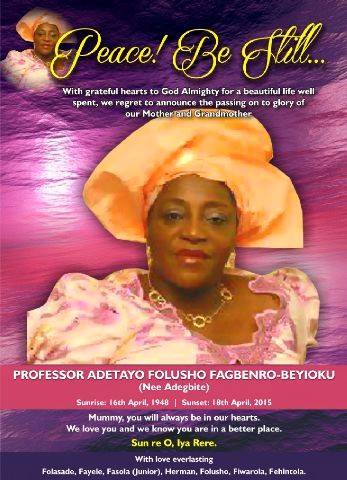
My former lecturer and supervisor Professor Adetayo Foluso Fagbenro-Beyioku passed away on April 18 2015. She was aged 67.

Professor Adetayo Foluso Fagbenro-Beyioku

Professor Adetayo Foluso Fagbenro-Beyioku

Mummy as we fondly called her was born on April 16, 1948. She attended Queens College in Yaba between 1960 and 1964. She also attended Walthamstow Hall, Sevenoaks, Kent for her Advanced Level G.C.E in Physics, Chemistry and Biology between 1965 and 1967.

She was awarded the Bachelor of Science Degree in Biology in 1971 by Georgetown College, Georgetown, Kentucky and Master of Science Degree in Microbiology in 1975 by Roosevelt University, Chicago, Illinois.

She returned to Nigeria and attended the University of Lagos where she was awarded the Doctorate Degree in Medical Parasitology in 1988.

Adetayo Fagbenro-Beyioku joined the services of the University of Lagos as Research Fellow II in 1980. She rose steadily and was appointed Professor of the Department of Medical Microbiology and Parasitology, School of Basic Medical Sciences, College of Medicine, in 2003.

Professor Beyioku was a former Deputy Provost at the College of Medicine of the University of Lagos. She was also a former member of the University of Lagos Governing Council.

She was buried according to her wish (after a private ceremony) on the same day she died.

Until her death she was one of Nigeria’s leading voices in the field of malariology.

In various ways, ranging from research, publications, participation in health programs, formulation and implementation of policies to mentoring students mummy was one of those who ensured that the study and knowledge of the malaria parasites remain relevant in Nigerian medical schools and research institutions.

A quick survey of some recent publications in malariology indicates that mummy contributed immensely to our knowledge of malaria epidemiology, immunology, chemotherapy and prevention.

Recent publications with Professor Beyioku’s name:

A current analysis of chemotherapy strategies for the treatment of human African trypanosomiasis

Variable geographical distribution of Blastocystis subtypes and its potential implications

Identification and characterization of microsporidia from fecal symptoms of HIV-positive patients from Lagos, Nigeria

Comparative studies of entero-parasitic infections among HIV sero-positive and sero-negative patients in Lagos, Nigeria

Strongyloides stercoralis and the human immune response

____________________

Mummy wrote her name in the Nigerian Medical Hall of Fame. She did with an indelible ink as her name and contributions will be cited in literatures and projects for generations to come.

People will talk about her as a good mother, a dedicated wife, a wonderful mentor and an exemplary lecturer/supervisor.

For a long time to come mummy’s work will be carried out and reflected through her postgraduate/research students. Some of her previous students are now professors, associate professors and senior research fellows in various institutions and universities around the world.

Below are the tributes written by some of mummy’s former students: (in no special order)

___________

Tribute 1  Written by Bolaji N. Thomas, Ph.D. Associate Professor, Immunology & Molecular Biology, Department of Biomedical Sciences, Rochester Institute of Technology, Rochester NY 14623. Email: bolaji.thomas@rit.edu

I write not just as a former student, but as a member of the “family”. Professor Beyioku was an advisor and mentor. We call her Mum because she does that one thing, which others would not or cannot, and does it superbly well-LISTEN. She was the support we needed to go through our programs, the calm when things seem difficult and the laughter needed to break the tension and unexpected awkwardness. I recall the days of chatting over coffee, generating research ideas and brainstorming on how to bring the ideas to fruition; the sense of equanimity and the gentle guidance along the way. I learnt a lot from you. You left too soon but be sure we will keep the banner flying. Goodbye.

Tribute 2 Written by Dr. Adekunle Sanyaolu, Associate Professor of Medical Microbiology & Immunology, Saint James School of Medicine, Anguilla, BWI.

This is a tribute to a great mother, Mentor, and Teacher. Professor Adetayo Fagbenro-Beyioku was a dedicated teacher and a loving mother to her children. She made a great impact in the lives of her students and children with her compassion. As a good teacher, she took us, shaped our thoughts and nurtured us in our career path in life. In addition to imparting training, she also inspired us to be good leaders and be compassionate to others. Reminiscing our school days, she showed great interest in our career development and provided advice and guidance to our social lives. Without her guidance and support, we will not be where we are today. We will miss her support forever. Adieu! RIP.

 “Most people end up with no more than few people who remember them, however, teachers have many more people that remember them forever”……..Anonymous.

Tribute 3 Written By Dr. Nnaemeka Iriemenam

Professor Fagbenro-Beyioku was a great tutor and mentor to all her students. Each one of us benefited from her immense and vast expertise. Mummy as we fondly called her nurtured us to be what we are today in the world. Her dedication to service, humility, hard work, and intellect shaped our respective career development. You are highly missed by your students and your legacy lives in our days. Adieu!

________________

To conclude these tributes in honour of our former lecturer and supervisor, l asked one of her daughters (Yele) some personal questions. I wanted to know what she missed most about her mother. She told me that she missed everything about her. That sums up mummy: She was very caring and she meant the world to her children.

It was this motherhood that she brought to her office and to the job.

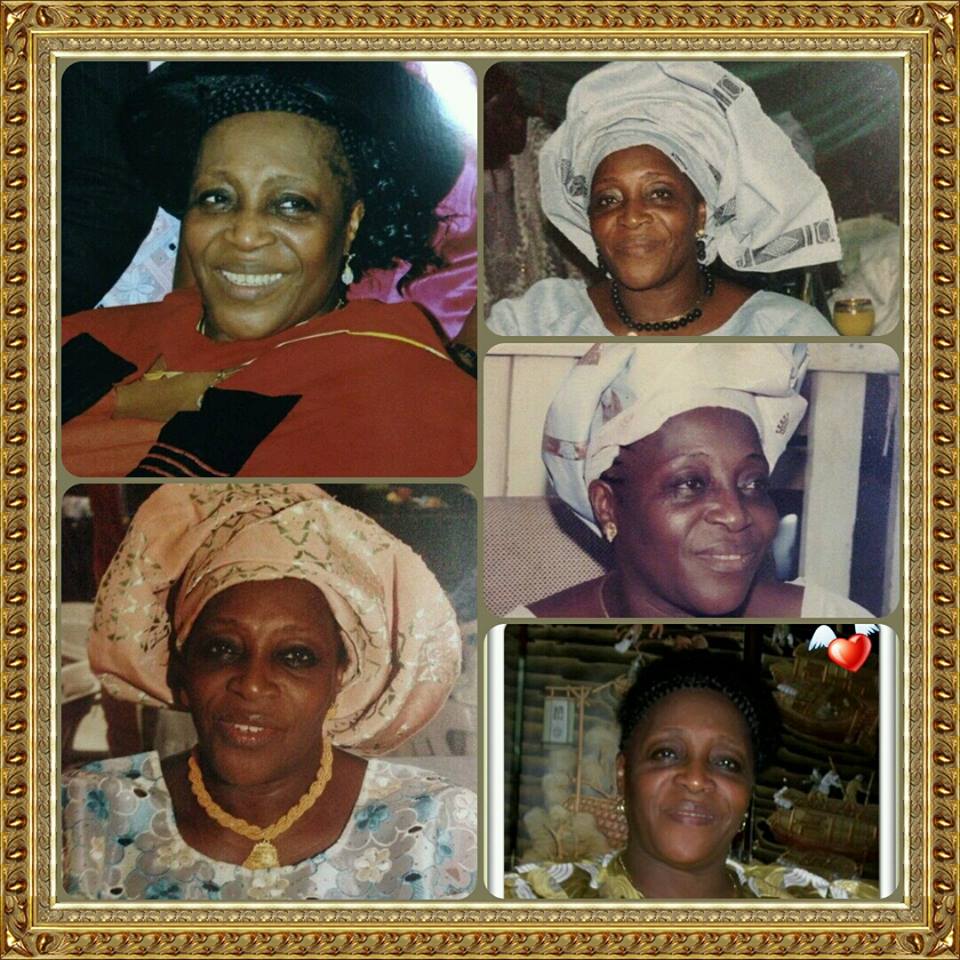
Professor Adetayo Foluso Fagbenro-Beyioku

Professor Adetayo Foluso Fagbenro-Beyioku

Personally, I remember all the laughter l took with me whenever l was leaving her presence. It touches me how she remembered all the things/information l shared with her during my postgraduate days at CMUL. I remember how at just 29, she allowed me to lecture one of her courses-Medical Parasitology for 300 level medical students.

Mummy’s death came to many of us as a shock and one of us Dr. Ninan Obasi is yet to find the words to express his shock.

Professor Adetayo Fagbenro-Beyioku will be missed by everyone that knew her. She touched many lives directly and indirectly and in special ways.

Mummy is survived by children and grandchildren.

May her gentle soul rest in eternal peace.

Goodnight mummy!

_________

Footnotes

The University of Lagos honoured late Professor A-F Beyioku with Academic Procession/Commendation Service at The New Great Hall, CMUL, Idiarabla on July 31 2015.

This piece is published to coincide with her Final Burial Ceremony (Thanksgiving and Reception) on Saturday, August 1, 2015 at 11:00 a.m. at the Divine Events Centre, Shepherd Hill Baptist Church, Obanikoro Bus Stop, Lagos.

Acknowledgements

Thank you for your contributions:

Dr. Bolaji Thomas

Dr. Emeka Iriemenam

Dr. Adekunle Sanyaolu

Thank you for our discussion:

Dr. Ninan Obasi

With additional information from

http://campuslife.unilag.edu.ng

http://www.akahitutors.org

aderounmu@gmail.com

Ebola, May Your Days Be Short (A Facebook Note)

Adeola Aderounmu

Which Way Nigeria?

Which Way Nigeria?

I can’t believe I am writing about Ebola. I tried hard to skip it. I couldn’t sleep last night,so you can understand why.

Maybe one day people will put their heads together in that part of Africa-The Sub-Saharan and put an end to mental slavery.

Maybe this is the time to call Nigerian medical researchers together from all over the world. Sadly I was one of them until 2004 when I walked away (don’t worry why I did what I did, life has since moved on).

Sincerely my views are wide and vast. That’s why the article is going ahead; but I don’tknow if I’ll publish. I’ll make the call and probably suspend my story about The Mad Kings.

It doesn’t matter now if Ebola was modified or invented as a biological weapon or not.

What has happened is that the list of Nigerian national emergencies just got longer. Don’t miss the point though that Malaria the number one killer in sub-Saharan African will terminate several lives especially children under 5 years of age before you finish reading these few lines.

Drug discoveryresearch is one of the most challenging worldwide; it could take half or even more than half of a scientist life if he/she does not derail and if the funding is flowing.

Many people are worried that there is no medicine for Ebola in Nigeria for example. They are not even asking, where is the malaria vaccine?

Ask yourself: Who wants to stay on a drug discovery research for 20 years or more with limited or no funding when an ordinary local government councillor can amass a wealth of 10 billion naira in one political season? Where is the inspiration going to come from?

I am even suggesting that the road to the malaria vaccine may be lying on the shelf somewhere at Idiaraba. l hope someone goes looking soon.

I am on the 4th page of my article (Ebola, May Your Days Be Short). You can guess how many questions and issues I have raised as a medical parasitologist / assistant lecturer at LUTH even before 2002. Don’t worry about how my position was terminated at Idiaraba as I struggled to put things together here in Sweden. Worry about your loved ones, and see what you can do to fight for your own freedom in down town Bongo.

Ebola, may your days be short because Nigerians have real issues to deal with. Issues that will shape the rest of their lives.

(copied from my facebook note)

http://www.facebook.com/adeola