Northern governors and the politics of oil BY REUBEN ABATI

Culled from the Guardian Newspaper Friday August 1 2008.

THE big news of the week in my estimation is the declaration by the chairman of the Forum of Northern Governors, the Chief Servant of Niger State, Dr Mua’zu Babangida Aliyu at a programme tagged First Northern Agricultural Summit on Monday, July 28, to the effect that Northern Governors have resolved to turn their back on oil revenue and develop the agricultural resources of the North. Dr Aliyu was speaking on behalf of the 19 Governors of the Northern states of Nigeria, and at the same forum, his views were further echoed by the Adamawa state Governor, Admiral Murtala Nyako. Dr Aliyu declared: “The future of the north lies in our hands. We should today begin to shape our destiny. As a Nigerian of Northern extraction, I feel very unhappy when somebody describes me as a parasite because of oil, when I know that I have the capacity to solve my problems and probably do even better through agriculture and education.” And so the North wants to go back to agriculture, with the hope that the financial sector of the economy will provide necessary support.

The politics of this declaration is important: the Northern Governors are responding directly to widespread insinuations in the Southern part of the country that the North is rather parasitic, contributing little to the commonwealth and yet getting more than a lion share of the national cake. Over the years, this distrust of the North has been expressed ever so loudly by Southern leaders and interest groups; thus turning geography into one of the more delicate sub-texts of Nigerian politics. Issues of contention include the population of the north, the political delineation of the North, resource allocation, the relatively low contribution of the North to national GDP, and the unusually large presence of the north in positions of power and authority. At the centre of this is the politics of oil, the allocation of federal revenue accruing mainly from the sale of crude oil.

The ThisDay newspaper in reporting the Northern Governors quoted them as saying: “North can survive without oil”. The Champion gave the story an even more provocative edge in its headline: “To hell with your oil: North tells South”. This is perhaps the most radical response coming from the north so far on the question of oil and its control since 1958. Before now, the Northern intelligentsia had tried to argue that the crude oil in the Niger Delta belongs to all Nigerians and not to the owners of the land from which it is extracted. The late Dr Bala Usman on many occasions even pushed a curious argument based on geology to wit: the oil deposits in the Delta flowed, over the years from the Northern parts of the country, and so the real owners of the oil in the Delta are the people of the North. A second notable response was the attempt by the then North-dominated Federal Military Government to find oil by all means in the North. So much money was spent on a search for oil in the Chad Basin, until the explorers got tired of searching. And now in 2008, the Northern Governors, for the first time have declared that “the Niger Delta can go to hell” with its oil and that without oil, the North can and will survive.

One of the earliest reactions to this came from the Arewa Consultative Forum, the social and political forum for Northern leaders, with the ACF saying that Northerners are indeed “lazy and parasites who rely on other regions for survival. There is no reason to run away from the truth.” But in s strange balancing act in the same statement, the ACF blames the Niger Delta for the economic woes of the North because according to it, people of the Niger Delta raided the Middle Belt for slaves during the slave trade era. All of these seemingly entangled issues can be taken apart.

The intervention of the ACF is at best a form of damage control, for if prompt effect were to be given to the wishes of the Northern Governors, the development process in the north which is essentially dependent on oil revenue will grind to a complete and final halt. But Dr Aliyu and his colleagues could not have been calling for a sudden stoppage of the sweet and free funds coming for the Federation Account. Their statement was clearly politically inspired and aspirational in terms of their development projections for the North. But talk is cheap. However, it is not only the North that is dependent on oil, it is not only the Northern states that are parasitic, nor is it only the people of the north that have become lazy. The curse of oil affects every part of Nigeria and all the people. Nigeria’s national productivity index is one of the lowest in the developing world.

The black gold is at the root of most of the ills in the Nigerian society: the laziness of the leadership elite, the bowl in hand, beggarly conduct of the states and the imposition of unitarist modes on the governance process in spite of the federalist principles in the Constitution. It is the entire country that is lazy and parasitic therefore: and it is one of the reasons why the people and the militants of the Niger Delta have had to continue to remind the rest of the country to become productive and make a contribution to the national pool instead of stealing Niger Delta resources in a greedy and unfair manner which leaves nearly nothing for the real owners of the resources. This wake up call had been long in coming but it is now more strident with the insistence of the people of the Delta on federalism, the militancy in the creeks and calls for resource control.

It is perhaps not difficult to see why the North is specially targeted and labelled an unproductive part of the Nigerian Union. The ACF accuses the people of the Niger Delta of raiding the Middle Belt for slaves during the slave trade era. The slave trade ended over 200 years ago. Where is the connection with the development crisis in the North? The ACF’s statement in this regard is meaningless, and this is unfortunate coming from the same ACF that is humble enough to admit that the South is saving the North. The problem with the North is its elite. Nearly every politician who becomes a big man in the North wears a big babaringa and refuses to work. More than any other group in Nigeria, the northern elite have had more access to state resources and more control over the same resources, but this has not been used to bring development to the people.

The same oil resources that Southerners claim Northern leaders have taken have largely been used to oppress the poor in the North and sustain feudalism. In this regard, the average Northerner is just as aggrieved as the average Southerner, for in the end, the patterns of dispossession imposed on this society by successive governments at all levels have produced uniform grief. The underdevelopment of the North has nothing to do with the slave trade; it has a lot to do with the attitude and lifestyle of the Northern man of power. Northern Governors trace the de-industrialisation crisis in the North to “international conspiracy against the North”, If there is any conspiracy at all, it is internal and it is the conspiracy of the northern elite against their own people.

One example: Governor Danjuma Goje of Gombe state has approved for himself and his predecessor in office a sum of N200 million as “executive pension”. The North, like the South, is in need of new leaders, not rent-collectors. If Northern Governors want development, they must begin with changes at the level of attitude and lifestyle. Nothing in Northern agriculture as proposed can sustain their present lifestyle. Vice Admiral Murtala Nyako, the Adamawa Governor, was right when he lamented as follows: “No nation has ever enjoyed lasting peace and stability or could ever survive when only a few of its citizens wallow in wealth and affluence at par with the rich of other nations, while the rest of its citizens are entrapped in poverty.. the simple truth is that the above reality obtains more in the North than other parts of the country”.

Northern Governors have been holding meetings since 1961, and at every meeting, they talk about the same issues – agriculture, education and development. But nearly 50 years later, there are more poor people in the north than other parts of Nigeria. The streets are full of distracted kids, with bowls in hand begging for alms during school hours. When UNICEF reports that more than ten million Nigerian children of school age are out of school, they can be found mostly in the North.

Northern Governors want to focus on agriculture, but to use agriculture as a launch pad for growth and development, the states must invest first in education. Who will work on the farms that the North will set up? In a few years, the growing population of almajiris on Northern streets will be old enough to be mobilised for riots not for any productive activity. It is a shame that many years after independence, the North continues to enjoy an affirmative action privilege in education and politics, which easily annoys Southerners who feel that they face much stiffer competition in seeking and gaining access to opportunities. Who will manage the agricultural renaissance of the North? This same set of fertilizer-stealing, rent-collecting elite? And where is their blue-print?

North-South relations in Nigeria are often constructed in form of rivalry and competition, and this is discernible in the tone of the statements by the Northern Governors and also the ACF. But it is an unhealthy competition that promotes further divisions. Rather than dismiss the Niger Delta and its oil, the Northern Governors should show humility and gratitude. If they are serious, they should be more interested in raising constitutional questions and seeking reviews which would free the North and other parts of Nigeria from the tag of “parasitism”, and which in the long run will ensure a return to federalism under which every state in Nigeria will be required to become productive. Under that new arrangement, the Niger Delta people will be glad to go to “hell” as advised
THE NIGER DELTA WAR: Justice will bring Peace

By Adeola Aderounmu

Take it or leave it, the war has been declared on both sides. The militants (in as many factions as possible) have declared a war on the Nigerian State for quite a while now. To deny this is to be insensitive to the killings that occur daily in this area. It will be a complete aberration to miss the interpretation of the spate of kidnappings and insecurity in this region as a war.

I have written about this war before in October 2006 and August 2007. Those articles were based on my encounters with a friend who works in Port Harcourt and my brother who is constantly exposed to the perils of this region because he is a marine engineer. When you hear firsthand accounts of what is going on in the Niger Delta, you will agree that a war was declared on Nigeria in the most silent way possible.

Whose fault is this war? Well, blame it on the Nigerian Federal Government and also on the various state governments in this region. Indeed, the militants are not saints too. Each of these 3 parties has serious faults but the bulk of it rest on the table of the (usually) illegitimate governments that have occupied the center in as many years as possible. Today Nigeria is still governed by an illegitimate government!

And that illegal government has now gone to Britain to buy guns and other weapons to counter the war in the Niger Delta. This is the solution that the evil government in Nigeria has for the people of the Niger Delta. The useless government is also to receive all kinds of military assistance from Gordon Brown’s country. Britain and the US will go to any extent possible to protect their interests. If it means brothers killing brothers in another country, so be it! In Nigeria, the oil deposits in the Nigeria Delta remains the most important thing to the British and the US. It is irrelevant to them that the government is illegal or bastardised.

In my own words in one of my previous posts on the Niger Delta. Rather than concede defeat, the Nigerian government will go to war with the militants if the need arises. History will repeat itself, fatally. The reason is not farfetched. This country that has been run by mad men since 1960 is totally dependent on oil and oil exports. There has been a total neglect of agriculture, tourism, science, medicine, technology and all that is needed to make a country grow.

Northern Nigeria and the rest of Nigeria look up to the oil in the Delta for money to run every little details of our National Life! In the process, there has been absolute neglect for the welfare of the indigenes of the area. The various states government in this region are also guilty of neglecting the people because the regional politicians stole money and embezzled as much as they can-the people can go to hell!

In addition, the foreign companies that operate in this area have not done enough to assist in the plights of the indigenes. Instead, they have continued to pollute the land and water. The problem of pollution has been worsened by illegal bunkering and the activities of the militants who also steal oil to sell and finance their war.

The results are here with us today. Two or more wrongs will never make a right. War is not the solution. It is not the way out. Peace talks or Niger Delta Summit is not the way forward. There have been many summits in the past, what happened to the outcomes/deliberations?

The Niger Delta issue is one of the many atrocities that the Nigerian State has committed against the citizenry. What is actually needed in the Niger Delta and indeed Nigeria is a total transformation of lives into that which is worth living. The targets should include letting clean water run in every home, to provide decent schools for the children, good roads and modern hospitals.

These are provisions and conditions that should have been made without demands. Where serious environmental damage has occurred, the communities should be compensated depending on the degree of damage. The oil companies in the Niger Delta should clean up their mess and pollute no more. The Environmental Protection Agency must ensure strict compliance.

Power supply in Nigeria is near zero percent! Such a serious problem should be tackled wholeheartedly as it can transform the economy positively. Agriculture should be re-initiated, expanded and mechanized. The abundant mineral resources in the country should be put to positive use to bring about economic growth.

Education, basic infrastructure, housing and social welfare should be re-engineered towards giving Nigerians a better life. The eradication of poverty should be pursued zealously and dedicatedly.

Corruption, nepotism and tribalism should be phased out of our existence. We should learn our priorities and set them straight and right.

Nigeria is supposed to be a great country and a model for Africa. Unfortunately she is regarded as a sleeping giant in the heart of Africa. If Nigeria permits it, her land will become like the rest of those places where Britain and America are spearheading wars.

Surely, we don’t want that in our country. We must look inwards and solve our problems. We must find peace and the best way to do this is to ensure that there is JUSTICE.

Energy, Security, the Food Crisis and the Niger Delta By the Liberty Forum

    Written by Kayode Ogundamisi, the Liberty Forum

Peace Not War! We Need Not Another Darfur In Nigeria.

We call on Great Britain. We call on people of the British Isles and the children of great men and women that make Europe what it is to day: a land of freedom and opportunities We call on women and men of goodwill, students, workers and the business class, we call on armed and defenseless people alike, royals and commons, Lords and honorable, to prevail on the Nigerian President Umoru Yar Adua, whose election into office as Nigerian president was roundly condemned by the European Union, EU-having been characterized by rigging, stealing of ballot papers by soldiers, deployed unto the streets and corners of Nigeria, and who killed and maimed voters- to stop fooling the government of Britain on the real situation in the Niger-Delta, Nigeria’s oil hub, which has now been highly militarized first by the Nigerian federal government, and now by militant freedom fighters who largely represent the indigenous communities in the region.

Yar Adua, a Fulani, whose grand parents led the 1804 Jihad against the black-skinned African population, represents the interest of the feudal and Muslim North, and have ruled and manipulated Nigeria to their wish and caprices since the Islamic revolution, which seek to continuously put Nigeria in the pocket of this few class.

Oil, which is the main source of revenue in Nigeria, is found in the Niger-Delta, home to indigenous population. These communities, due to large-scale corruption, looting of the public treasury by the leadership at the centre remain largely underdeveloped.

The poorest of the poor live in these communities, their culture undermined, their heritage submerged, their hope dashed, their future traumatized and their children without any future.

Soldiers of Northern origin are posted to these territories, and as expected, they rape the people, as it was in the case of Choba a rural indigenous Nigerian Village (1999), kill them and instill fear on them.

The Yar Adua government is similar in character to Omar Bashir’s regime in Sudan, he wants to wipe out the indigenous population, and he cannot do it without help from a super power like Britain.

The late Ken Saro Wiwa, remember him, renewed the campaign for environmental and political justice in the Niger-Delta, but in 1995, he, alongside eight others were hanged and acid was poured on their bodies by the Nigerian state.

A democratic regime which came in 1999 was thought would address the problems of the Niger-Delta, but the Nigerian state did not change in character and form. Instead, it became more vicious and bizarre, all in the bid to continuously subjugate and muzzle the ethnic minorities in these territories. In 1999, Yar Adua’s party, the Peoples Democratic Party, PDP then led by President Olusegun Obasanjo sent 10,000 soldiers to Odi, an Ijaw community of 20,000 people. After 72 hours of military action, the only building remaining in Odi was a post office. 1,200 people were killed and hundreds were missing. What more is a genocide than the maiming of women, children and the unarmed and today the perpetuator of that act, General Olusegun Obasonjo roam the streets of Yaradua Nigeria, neither facing trial for corruption or war crimes.

Today the Niger-Delta people, having waited in vain for justice since 1959 when oil was discovered in their homeland, have taken up arms against the Nigerian state. This is against the background of age long outrage among largely Christian Southern Nigeria communities, that they are tired of living in Nigeria, a country ruled by a small fundamentalist group, a country that offers no hope for her citizens, a country that destroys the best of human values and a country whose citizens have been made to become a huge burden on the international community, considering the large number of exiles, some of who have taken up professional jobs in Europe and America and many of whom have taken into drugs, prostitution in Italy and cyber crimes.

Nigeria is an artificial creation, put together, without the consent of the communities, in 1914, following the sharing of Africa into spheres of influence in 1885 at the Berlin Conference. Now, the Yar Adua tribe are on top, and they do manage, at all times, to install their stooges in each of the 36 states of the country, whereas non of the states enjoy the benefit of federalism, which each of them heavily dependent on the centre in all areas including the registration of vehicles, control of ports, police and even as little as the right to create and run counties and the right to chose their political leaders, which must be screened and approved by the centre government.

Apart from the Niger-Delta, the Yoruba and Ibos of the South and the minorities of the middle-belt in the North are asking for self-determination up to the point of opting out of Nigeria. Many of these communities having watched several recommendations chuck by the government into the thrash bin, have decided to take up arms against the Nigerian state.

Britain was aware of this serious problem in Nigeria. In 1957, shortly before Nigeria got independence in 1960, Brittan set up the Willinks Commission, which recommended that revenue be shared 100 percent on the basis of derivation. Today, only 13 percent has been approved and just as recent as in 1999, for the oil producing communities. On top of all this is the fact that a credible election in unlikely in Nigeria under her present structure. This is the gist of this whole problem in the Niger-Delta and in Nigeria.

Another peace summit, the third in 12 years is in the offing, but expectedly, nothing is likely to come out of it, because while the summit is in top gear, Yar Adua is shopping for arms in Britain and has heavily militarized the region since the past 10 years.

A peace summit, even if to be chaired by Britain is what is needed. We need no longer another Iraq in Nigeria. We need no weapons that will be used by an illegitimate political class against the ordinary people of Nigeria.

Self-determination is the substance and the United Nations recognizes this demand under article 27 of the Universal Declaration of Human Rights. Help save Nigeria from war, help save Britain from being fed with lies and propaganda by one of the worst set of leaders in Africa.

As British Nigerians and Nigerians Resident in the United Kingdom with Stakes in Both Countries we demand as follows.

OUR DEMANDS.
• Prime Minister Gordon brown should withdraw his offer for military assistance to the Nigerian government.
• That the British government should commence investigation into the private accounts of past and current Nigerian public office holders with a view to recover stolen money and return same to the people of Nigeria.
• The Nigerian government should stop the continued militarization of the Niger Delta region.
• The Nigerian police should be adequately equipped to deal with law and order issue in the Niger Delta.
• That only a genuine restoration of the rights of the Niger delta people and all oppressed people in Nigeria will bring peace to Nigeria.
• That if the labor led government of Prime Minister Gordon Brown is in any way seen to join the Nigerian government in committing acts of genocide in the Niger Delta, the Liberty Forum and its affiliate organization shall commence immediate campaigns against the Labour Party in the afro-Caribbean communities in the United-Kingdom.
Signed.
Kayode Ogundamisi
Convener: The Liberty Forum-UNITED-KINGDOM
+447951402986
+442030150739

My Random Reflections @ 36

My Random Reflections @ 36

By Adeola Aderounmu

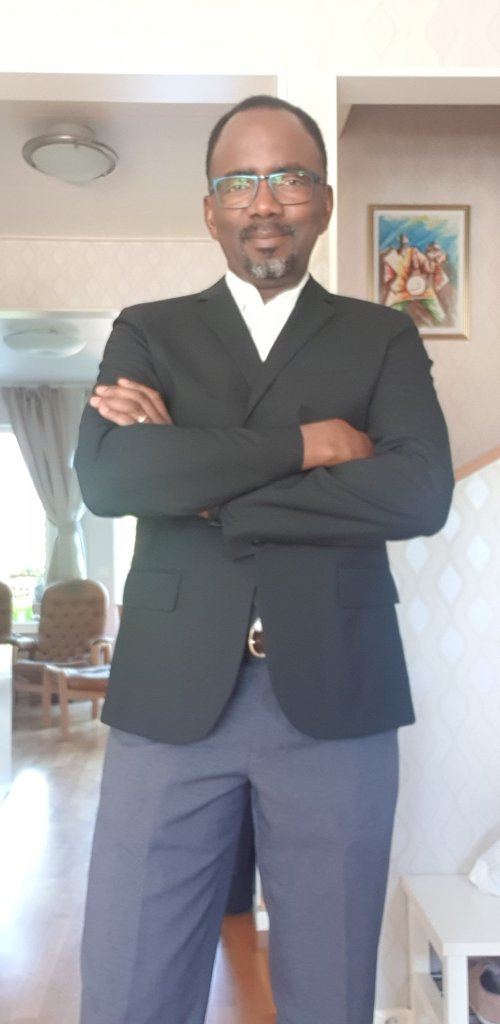
Image from 2020, 12 years later

I am writing this article to mark my 36th birthday. I was born on July 12 1972 right there in the heart of Africa. As a child I still remember vividly my dreams. It is absolutely impossible to forget all those memorable moments. In my own literary world, I also have what I’ve called thoughtless times.

I have never lied about my childhood. It was hard, very hard! It was hard to find food on the table and I will never be ashame to write about that in my autobiography. My father is an honest man and I am proud of him. My mother is more important to me than an angel. I will never forget who my parents are. They are one of those who never thought Nigeria could become the hell it is now.

I have come to accept that my writings are seriously influenced by my childhood. I am eternally grateful to my parents who gave everything possible to ensure that all their six children were educated. In my life, there will be many more people to appreciate and acknowledge and this is not the appropriate forum.

Yet, teachers like Mrs. Obi, Mrs. Aregbesola and Mrs. Nwuoha who taught me in the late 70s to the mid 80s in Central Primary School in Festac Town will never be forgotten in my life time. Mrs Obi told us that nearly does not catch a bird. How could I forget that? It was Mrs. Nwuoha who ensured that the best male and the best female students in her class would be the class captain and assistant. How can I forget that when I think now of the implications of National Character in a comatose country called Nigeria?

My dreams and aspirations were not only shaped at home, they were equally modified at school. They told me that I attended Jakande poultry school but who cares? I tried though to gain entry into the then famous Ijanikin but you can tell that my family was not well connected and we had no money to go the length. Above that, I wasn’t keen to go back one step in the name of Unity school.

My moulding was completed under great teachers at Festac Grammar School and the University of Lagos. I left Nigeria in 2002 as I pursued my third degree and after giving more than 10 years into the noble teaching profession outside permanent or regular employment. My last and highest stint was a GA position at the College of Medicine in Idiaraba. In 2004, I decided that I’d had enough of the academic world (so I thought) and I virtually gave away a part of my dreams. It has not come with any regret!

Some stories will be better narrated in books. There is always more to certain issues than the eyes really behold at a given point in time. The mind remains a terrible thing to waste and one of the greatest crimes a man can commit against himself is to become static. I can say that I took my chances to another lane and I decided to live life in the new perspective that I’d seen it since my entry into another world. It’s now like another life.

If life begins at 40, it means that a Nigerian male and female has only 6 and 7 years to live respectively according to the United Nations life expectancy figures. Life does not begin at 40 or maybe my own life will not begin at 40. I believe that my struggles through thick and thin during those formative years in Nigeria and here in Sweden are parts of my life. I have started living before 40. It may require hardwork or dedication, it may be destiny, it may be the hand of fate, it may be luck, it may be opportunities, it may be opened or closed doors, whatever it is I have been living.

I woke up today receiving a number of sms and phone calls from families and friends scattered all over the world. Several emails have also popped up and I’m delighted to be surrounded by thoughtful people and organisations.

I keep reminding myself of what the Asians recommended for a fulfilled life. Have children, build a house and plant a tree. We have been planting trees around our new home and today I will celebrate my housewarming and birthday party with several friends and family members here in Sweden.

As I celebrate, my thoughts are with my families in Nigeria. My thoughts are ever with all Nigerians who are going through those moments and extremely hard situations that I’d left behind. I hope they find their dreams and make them come true because there is only one life to live and life can never be rewind.

I dedicate this piece to two wonderful women. Anita Westlund is 84 and has been diagnosed with cancer of the liver. The great-grandmother to my daughter Anita is one of the loveliest women I’ve ever met and I’m hoping that the rest of her life will be spent in peace.  Doyinsola Aderounmu is 68 and she has not been on her feet for almost 3 years. We have not given up on my lovely and beautiful mother.

(Anita Westlund died at the ripe age of 84 on 10th August 2008, May her soul rest in peace). 

The Nigerian Guardian Editorial on Mugabe’s Zimbabwe

    Zimbabwe: A tragic failure of leadership


THE NIGERIAN GUARDIAN JULY 3 2008

IN a demonstration of utter contempt for the international community and indeed for the Zimbabwean people, President Robert Mugabe stood as the sole candidate in the country’s run-off presidential election which was held last Friday, June 27. Two days after the one-man race, 84-year old Robert Mugabe was sworn in as president of Zimbabwe for the sixth time.

The episode undoubtedly forebodes much worse for the country and its people in the months to come. At the personal level, it provides a vivid illustration of how a leader could fall from heroic heights into infamy and illustrates what Nelson Mandela has called a tragic “failure of leadership.” Robert Mugabe has demonstrated that his love for power is in inverse proportion to his disdain for rights of many of his people. This is a character flaw of tragic proportions, whose consequences are bound to affect the destiny of a whole nation.

The crisis began shortly after the general elections of March 29 when President Mugabe’s 28-year long rule was challenged by Morgan Tsvangirai of the opposition Movement for Democratic Change (MDC), and by Mugabe’s former Finance Minister, Simba Makoni, who contested the presidency under a breakaway faction of the MDC. The Zimbabwe Electoral Commission released the results for the legislative election, which the opposition won with a clear majority, within a week, as stipulated by law.

Expectations were high from both citizens and informed observers that the presidential election would follow the trend in the legislative election. This optimism was bolstered by the fact that he had allowed the opposition candidate to campaign across the country without any molestation. There was also the added fact that the severe hardship induced across the country by hyper-inflation and economic collapse would be blamed on the incumbent government and sway the election in favour of the opposition.

However, the Electoral Commission refused to release the result of the presidential election, thereby adding political uncertainty to a polity already teetering on the verge of economic collapse. Amidst this uncertainty, the ruling ZANU-PF party and its storm troopers across the country began to take certain measures that reinforced the impression that President Mugabe was determined to cling to power. It took the Electoral Commission five weeks and a ballot recount to release the results. As expected, Morgan Tsvangirai won a majority of the vote with 47.9 per cent against President Mugabe’s 43.2 per cent. This fell short of the 50 per cent plus one required by law. The situation
called for a run-off election which was fixed for June 27.

The series of events that unfolded in the period leading to the run-off demonstrated President Mugabe and his party’s determination to do whatever was necessary to ensure victory. They unleashed a campaign of terror and intimidation on opposition party stalwarts, supporters and sympathisers. The MDC’s Secretary General was charged with treason and is currently in detention. Security forces hounded opposition party members across the country, while ZANU-PF storm troopers unleashed terror across the countryside, reportedly killing and maiming innocent citizens.

Whereas the opposition had been allowed to campaign freely before the March election, this was no longer possible anywhere in the country. Its rallies were disrupted both by security forces and ZANU-PF activists. Its presidential candidate was arrested several times ahead of the run-off. By the time the party threw in the towel, well over 80 of its members had been killed. Morgan Tsvangirai was compelled by the level of violence to withdraw from the presidential contest, and to seek refuge in the Dutch Embassy in Harare. This gave Robert Mugabe the electoral certainty he so desired. ZANU-PF’s objective, as was made clear on its campaign posters, was to ensure that Robert Mugabe secured 100 per cent of the vote.

In the end, the election was held in an atmosphere of intense fear and intimidation, with voters going to the polls because of the fear that those who could not show the indelible pink mark on their fingers to demonstrate that they had voted would suffer violent retribution. Robert Mugabe got what he wanted and was immediately sworn into office.

How could an 84-year old man be so determined to cling to power? How could a hero of the liberation of Zimbabwe brutalise his own society in his twilight years with scant regard to the past and to his place in history? Power is of course the best, or is it worst, aphrodisiac, and those who get drunk on it are condemned to self destruction, with the danger, sadly, that in the process of self-destruction, they could indeed destroy a country as well. This is the tragedy of Zimbabwe.

The consensus of African and international opinion is that the run-off election was a farce and totally undemocratic. Beyond that however there is little agreement as to what could be done to redress the situation. Western countries have condemned it and have unwisely threatened to reinforce sanctions which have already impoverished Zimbabweans.

The African Union, which discussed the Zimbabwe election at its summit in Egypt, merely called for talks leading to a government. This call has been rejected by Morgan Tsvangirai.

There is now more despair in Zimbabwe. Western nations must back off from threats of more sanctions and African leaders must become vigorous in sincerely and genuinely pursing peace in Zimbabwe between government and the opposition. At 84, there is not much Robert Mugabe can give his country except to exacerbate the present crisis. Any solution will therefore have to follow channels that would ease him out of power to enable the country re-direct its energies towards improving the lot of the people of Zimbabwe