The docking of Adedibu-one good news but….

Adeola Aderounmu.

Ok. Finally, one man who has been above the law in Nigeria finally got a taste of the law court. Adedibu was released on bail after been charged for activities capable of breaching the peace in Oyo and the entire country. 

 “The magistrate granted Adedibu bail in the sum of N500,000 with two sureties in like sum. The sureties must own properties in Abuja.”

There was jubilation in Ibadan when the news broke out that the man ABOVE the law was finally getting a taste of the law.

This is good for governance, that people can only be free if they are slaves to the law. It shouldn’t have taken this long to drag this man to the court. But that he was in court at all is a BIG step forward and that move should be applauded.

BUT this is my fear, this whole thing could be a kangaroo arrangement. Mike Okiro could have arranged this with Adedibu to make it seem as if he was doing his job well or to give more credence to the illegitimate government in Nigeria.

The reason for my fear is that beyond this arrangement/arraignment and bail, this man should not be a free man today. He has unleashed terror on innocent people, his activities has led to several deaths and anarchy in Oyo in the past.

It shouldn’t have taken Dora Akinyuli, the NAFDAC Boss, to bring Adedibu to court.

Justice must be done, Adedibu must answer to crimes that he committed. Until then, this whole arraignment and release on bail is too cosmetic. People should pay for crimes, for murder and other heinous activities so as to serve as a deterrent to others who are always bent on going against the rule of law.

Look at Nigerian roads! Look at madness!

By Adeola Aderounmu.

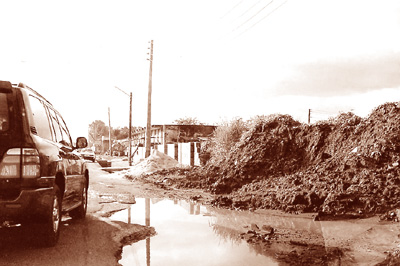
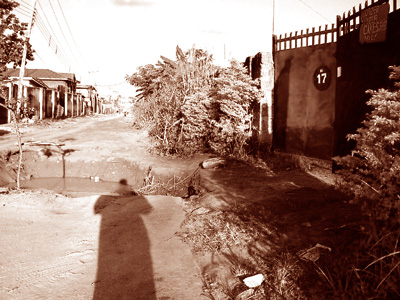
Courtesy of the Nigerian Punch Newspaper of Sunday 11th Nov 2007. Here are what typical Nigerian roads look like (Using Edo State as an example).

Road 1.Click to Enlarge ugborroad.jpg Ugbor Road

Road 2: Click to enlarge  ihamaroad.jpg Ihama Road

Road 3: Amadasun road amadasun.jpg

 These are examples of typical Nigerian roads where you are supposed to drive your car!

Now tell me, how can one useless governor claimed that he spent over 300 million naira to repair these roads. We all know that is a lie.

The truth is Lucky Igbinedion stole all the monies belonging to the people of Edo when he was governor.

Tony Anenih, the former minister for works and housing is also from Edo state. Look at what they are doing to their people!

Isn’t this a big shame? How can we continue like this? Isn’t it time the people wake up and send the likes of Lucky and Tony to jail? How long shall this show of shame last?

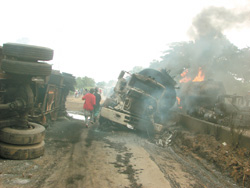
And here is another photo below from the Nigerian Guardian: This is Benin-Ore road. This road has been rated as the WORST highway in the world.

ore-road.jpg Benin-Ore Road, click to enlarge.

Now, Nigeria is the giant of Africa….very funny.

What kind of nonsense giant is that?

I mean, this is one of the richest countries in the world which has conveniently become home to some of the poorest people in the world. AND the people are just looking and living a life of misery, hopelessness and extreme poverty.

These are just examples, imagine if you have to travel round the entire country.

I maintain that Nigerian leaders are fools!!! They are the biggest fools in the world, from the illegal president to the stupid local government chairmen. They are fools and thieves.

They are heartless and mean, they just steal money and care for themselves only.

140 MILLION others are suffering materially, mentally, socially, healthwise and in many more unthinkable ways.

Giant my foot!

Update: 20-11-2007

This is what happens on Nigerian roads: click!

http://www.vanguardngr.com/index.php?option=com_content&task=view&id=1846&Itemid=45

Re: Nigerian Bloggers Mount Campaign

By Adeola Aderounmu.

Please read my post on Nigerian Village Square. I didn’t feel like posting it here all over:

 http://www.nigeriavillagesquare.com/articles/adeola-aderounmu/re-nigerian-bloggers-mount-cam.html

The Rise and Fall of Festac Town-Part 2

By Adeola Aderounmu.

After the mid 80s, the dwindling glory of Festac Town continued to take a turn for the worse. By the end of 1989, a lot of things have happened that revealed the recklessness of our administrators in Nigeria. The one that shook us most till today is how we lost our forest and all our playgrounds to construction of more houses in what became known as the fabricated and inglorious FHA plan B of Festac Town.

On W close of 5th Avenue, the popular FHA football field (where I spent my school breaks in primary school, watched glorious football tournaments and later played in competitions in my early teens) was sold to the first set of invasive millionaires that have just discovered Festac. We thought that was the worst that could happen. Wait! The expanse of playground on 23 Road, opposite D and E closes where virtually all schools in Festac Town usually host their annual Inter-House sports competitions was sold! Houses have since been built on them.

In Festac Town today, only one major field remains and this is the one adjacent to the former Inter-House sports ground. This one field that is now serving all the young football talents in Festac Town is the remnant of our several beloved playgrounds and parks. The small sand field on 322 Road where Victor Okechukwu Agali budded is a rare survival despite all the structures and shops that have grown around it.

In 1990 Festac, most parts of the Canal had been reclaimed and houses have been built on them. The forest that surrounded Festac before is now history. Today, all the grasshoppers and butterflies are gone while the monkeys and other wild animals suffered violent extinction. There are no more swings in the park-the park themselves have given away to a vicious plan B. The Federal Housing Authority (FHA) sold all our recreational centres. 

Even solid surfaces where Lawn Tennis was played around the neighborhood were not spared! Houses were built everywhere, on electric cables, on top of underground tubes for passage of human waste (sewage suck-away), in parking areas and any kind of space that you can imagine. There was a day a man’s house had to be pulled down partially to retrieve NEPA’s electric cable that ran under his house!

Overhead electric cables had to be constructed where houses cannot be pulled down or when the underground cables suddenly disappear from traceable paths. Even the infamous NEPA edifice at the end of 512 Road was built on a concrete-surface lawn tennis court! It was used as one of the two famous grounds for stone-field football before NEPA acquired the land. The only stone-field (previously a lawn tennis court as well) standing today is at 5th Avenue H1 Close or 23 Road X Close depending on your approaching point. This is the only place I have to play football whenever I am in Festac.

So, it happened that Festac in the late 80s and early 90s became a hot spot not only for Nigeria’s invasive millionaires but also for our corrupt politicians to flaunt their ill-gotten wealth. If you go to the popular Cocaine Avenue in Festac (also known as extension), the early settlers there are mainly popular but corrupt Nigerian politicians and some people whom we came to know later as 419 kingpins.

There are hardworking people as well who decided to join this invasion and of course the churches and mosques got their own share of the playgrounds. The giant mosque on 72 Road was built on one of the most famous football pitches in Festac Town! Many churches also built their worship centres on playgrounds. It was as a result of the rapidity with which houses sprung up on 4th Avenue extension that this area lost its original name and became known as Naira Burial Ground or Cocaine Avenue.

Today, this unnecessary overgrowth in Festac continues with the emergence of high class hotels, suites with swimming pools, several banking halls, fast food outlets, more petrol stations and explosion of the human population beyond the initial sustenance capacity of the festac village of 1977 to 1980.

The impacts of this negative growth and extreme carelessness of FHA is still revealing a sad situation in present day Festac. Crime became entrenched for obvious reasons. The corrupt politicians, the 419 kingpins and the subsequent emergence of high class hotels and suites may have influenced the making of the yahoo-yahoo boys in Festac Town. Festac Town acquired an international status for this advanced fee fraud crime thereby overshadowing the importance of the Black Art Festival of 1977.

There is no stretch of road in Festac Town that is not without its dangerous areas and pot holes. It was in Festac Town that I saw for the first time that cement can be used to substitute tar to repair roads. That reveals the extent of neglect that Festac is suffering in the hands of the federal government-the original owner of the estate, the state government-who don’t care so much about the estate and the local government with headquarters on 41 Road-whose sole interest is to collect tenement rate without regards to the mortgage agreements that many occupiers signed far back in 1977.

There are other vices and problems that typify the great fall of the once celebrated Festac Town. Sewage disposal is a major concern as houses have been built on the original channels that took the liquid waste to its terminal. Overflowing sewages are common sights nowadays and the tenants have to contribute money to private firms to clear the mess. Not doing that would have encouraged an epidemic.

The maintenance in Festac Town was neglected by FHA and all the houses especially the blocks of 16 and 32 flats now look very ugly. Some people contribute money and paint their buildings at some intervals depending on how soon the paints are washed away. The Primary Health Care Centre which we had in the beginning was very effective but the situation today is a sad one.

The availability of water in Festac is a dead issue. First, the taps went dried for inexplicable reasons. Then at a time, the water corporation was giving us water darker than Lipton tea. We were supposed to drink this reddish brown water coming from rusted pipes. Allow this water to settle and you’ll see your obituary staring at you in the face!

Ironically, Festac Town probably has the largest water reservoir in Lagos State. This structure lies today as a monumental waste on 22 Road, not far from TEXACO petrol station. It is impossible to re-count all the things that wasted away in Festac Town, from the shopping complexes that were misused and converted to religious centers to the stationary generators that were gradually torn apart by petty thieves and eventually removed by new land owners thus allowing them to build on electrical installations! 

 In 2007, 30 years after it was first inhabited, Festac is a far cry from the dreams of the founders. If the foreigners who were part of the construction of Festac Town houses and environment should visit the same Festac Town today, they will surely burst into uncontrollable tears (of sadness). The houses that Jack built 30 years ago now resemble 10th century attempts to modernize ancient Golgotha. 

No one used the bicycle tracks or perhaps we didn’t even realise that the tracks beside the main roads were meant for bicycles. Did anyone own a bicycle for the purpose of commuting? Make shift akara and dundun markets have taken over all these tracks. The damage in Festac seems irreparable. Many occupiers who arrived in 1977 have left the place more out of anger or frustration than the necessity to relocate to their personal houses or to rented places outside Festac.

If Festac had remained the paradise it was in 1977, perhaps the story would have been told differently. Sadly, Festac Town has come to symbolized one of the several places in Nigeria where children are growing up not realizing that their childhood had been stolen from them before they were born. Imagine the contrast between the wonderful atmosphere under which the early settlers in Festac brought up their children and the criminally inclined environment of the 90s that pervades in Festac to this day. This ugly scenario would have been prevented through proper planning.

Rather than invade Festac thereby accelerating the destruction of its original Master plan as they did in the 80s and 90s, the greedy politicians and other overnight funny millionaires should have solicited for the establishment of more estates similar to Festac Town across Nigeria. If they must live in Lagos, they could have demanded for the creation of Festac Town 2 and even Festac Town 3 in the suburbs.

For now, as the unfortunate residents of this extremely over-populated town, a micro-representation of the failure of the Nigeria nation, we are seriously faced with the hassles of crime, rage of violence, complete absence of drinkable water, disorganized transportation, bad roads, perpetual blackout, dilapidating schools and houses, scattered markets, stagnant drainage system, complete absence of recreational centers and youth delinquency.

Additionally, the emergence and activities of road-side estate agents and those who sold their flats or houses in Festac Town have made a complete mess of the purpose of the housing system. Festac Town is a Federal Government project that was grossly mismanaged and eventually left to rot away, if it must be salvaged in any way at all, the responsibilities rest squarely on the shoulders of the Federal Housing Authority. They should not have introduced the disaster called Plan B and they should not have reneged on their parts of the housing contracts.

That’s how we got to this point! (concluded). 

Nigeria, wherewithal thy Glory? 
The Rise and Fall of Festac Town-Part 1

By Adeola Aderounmu.

This year 2007 marks the 30th Anniversary of Festac Town as a residential area. Festac is still one of the largest residential estates south of Saharan Africa. When I started living in Festac Town in 1977 with the rest of my family, I was only 5 years old. Leaving number 26 Oni Street in Obele area of Surulere Mainland behind and arriving in Festac, in my eyes, was like finally reaching paradise.

My earliest memory of Festac was that my father left us behind in Surulere to prepare a wonderful place of abode for us. But I have no qualms that my infanthood was formed in Surulere. I remembered so vividly that song with which we entered Festac but maybe not in the correct words:

International year of the child, International year of the child, A year of joy, a year of faith, A year of education, Festac 77, Festac 77

The Festac Houses were thrown open the same year that Nigeria hosted the second World Black Festival of Arts and Culture in Lagos from January 15 to February 12, 1977. The Festival of Arts and Culture (hence the name FESTAC) placed Nigeria on the spot on the world stage at that time and the FESTAC houses readily provided accommodation to visitors from all over the world.

That glorious event brought more fame to this ever wealthy nation. It was interesting to see that many buildings and houses were not even completed at the time that the Festival was taking place. A lot of blocks of flats towards the West end of 5th Avenue were uncompleted (we called them uncompleted houses in the beginning and as kids, we went jumping from the 1st and 2nd floors of these uncompleted buildings down onto the heap of sand below).

The situation was the same for many blocks of flats and duplex apartments on 7th Avenue and 23 Road. Many people on 1st and 3rd Avenues concluded that the Oyinbo men built their own houses and flats while they left the remaining for the Nigerian builders. In their eyes, those on us at the east end of 23 Road and others at the tail end of 7th Avenue are living in the inferior parts of Festac Town (it was an inexpensive joke anyway). 

Festac Town houses were constructed to accommodate all classes of people in the Nigerian society-low, medium and high income earners. With as low as N1, N2 or N3 naira, depending on their income, people ballot for flats and houses and they got allocations on a mortgage basis. In Festac Town of the late 70s and early 80s, life was indeed very good.

Our existence was village-like (the addresses actually read Festac village at the onset) because at that time, there were a lot of friendly interactions that promoted community-type of existence. Our parents held regular meetings as new residents of a paradise village.

The population was so moderate you could tell the names of the visitors and friends that came to your house. My father could almost recite all the names and addresses of the people at each meeting. To this day, he still knows especially if those people are still living in Festac Town and they have not sold their flats or houses!

As children, we longed for the regular summer holidays when we played football. The playgrounds were many and they come in various shapes and sizes. I knew virtually all the football clubs and which communities they represented. Father Coaster was from 23 Road where I live, Net Bombers was from 401 Road and the Strikers came from the 7th Avenue. Festac Town eventually gave its fair share of players to the football world including footballers in the National team and other famous teams around the world: The Olisehs, The Ipayes, The Ekehs, Victor Agali, and Bimbo Fatokun just to mention a few. When we are not on holiday, we went to school near our homes. In the beginning the public schools (popular called Jakande schools) were named like this: school 1, school 2 up to school 12.

Eventually the schools took up definite names like Central Primary School, or 5th Avenue Primary School. There was a school on 7th Avenue close to where palm wine tappers carry out their noble jobs. That school till today is famously called Elemu primary school. The Palm tress are long gone anyway, having been replaced by houses! School time was fun especially the breaks when I went looking for butterflies and grasshoppers to catch. Sometimes we played in the sand with seeds of a special fruit called Agbalumo seeds-we called them stations.

Though Football always brought the entire people in Festac Town together, it was not the only thing that counted for us as kids in those days. We also took time out into the forest that surrounded Festac. There is a famous place along 4th Avenue called Canal. What looks like a small river flows through this area and there we went to learn how to swim-many of us could still not swim anyway.

Canal was forbidden for us but we went anyhow and many of us received beatings of our lives doing that. Our parents genuinely feared that we could drown.  Sometimes, heavy rainfall resulted to water being collected in some shallow valleys on this 4th Avenue and that was safe for us to swim in or we simply caught frog-fishes (Opolo-fish) and took them home as temporary pets. Even real fishes died when we took them home. We didn’t understand then that we could have moved them from salt water to fresh water.

As I grew up, I love Festac. I love school and I enjoyed the warm company of my friends and other people. It was while growing up in Festac that I didn’t see anything wrong with little boys playing or mingling with girls of the same age group. Before I was 10 years old, I didn’t see anything wrong with my participation in games like suwe and ten-ten.? I went on to do suwe when I was well into my teens.

That ideal communal beginning in Festac Town helped us as children to make friends across ethnic alliances. It promoted team work and gave us proper childhood. For real, we all spoke a common language, that is Pidgin English and almost everyone spoke Yoruba. It was later that I learnt about tribes and that the other kids spoke other languages to their parents at home.

Those whose efforts gave birth to this kind of housing project deserved the best commendations. The contributions of some people should be appreciated, for example, people like Fortune Ebie-the first Manager of the Festac Houses, the then Head of State Yakubu Gowon and the thoughtful Brigadier Mobolaji Johnson-the governor who gave out the expanse of land on which these magnificent structures were constructed. They had a dream which came true in the early settlers of Festac Town.

Festac was growing, more people were moving in and life was still worth living. The supermarkets were splendid. The kiosks were minimal in number and strategically placed. The nearby Agboju night market was clean, full of regular things to buy and sell. Electricity was okay and the giant stationary generators were fully installed.

The government managed transportation system was perfect with the famous Lagos State Transport Corporation (LSTC) red buses taking workers to their jobs in the morning and bringing them safely into Festac in the evening. I remember bus number 000 goes to Oyingbo. One woman called Mama Ibeji of blessed memory in our block was working with LSTC. Oh! How she loved that conductor job, she felt dignified. It was worth it in that fine uniform and the courtesy accorded to her daily in the neighbourhood and on the bus.  

It was when I got into the University of Lagos  in 1990/91 (to receive my first education outside Festac Town) that I realized that Festac Town houses and their residents enjoyed high rating among other places and people in Lagos. However, at that time, I didn’t know how to rebuff the image of Festac that is stuck or painted in the cerebral of these raters who don’t live in Festac. From sometime after the mid 80s to this day, Festac continues to tumble and transform endlessly into an arena that resembles more of a jungle than a town. How did we get to this point?

(to be continued)-Read the part 2!